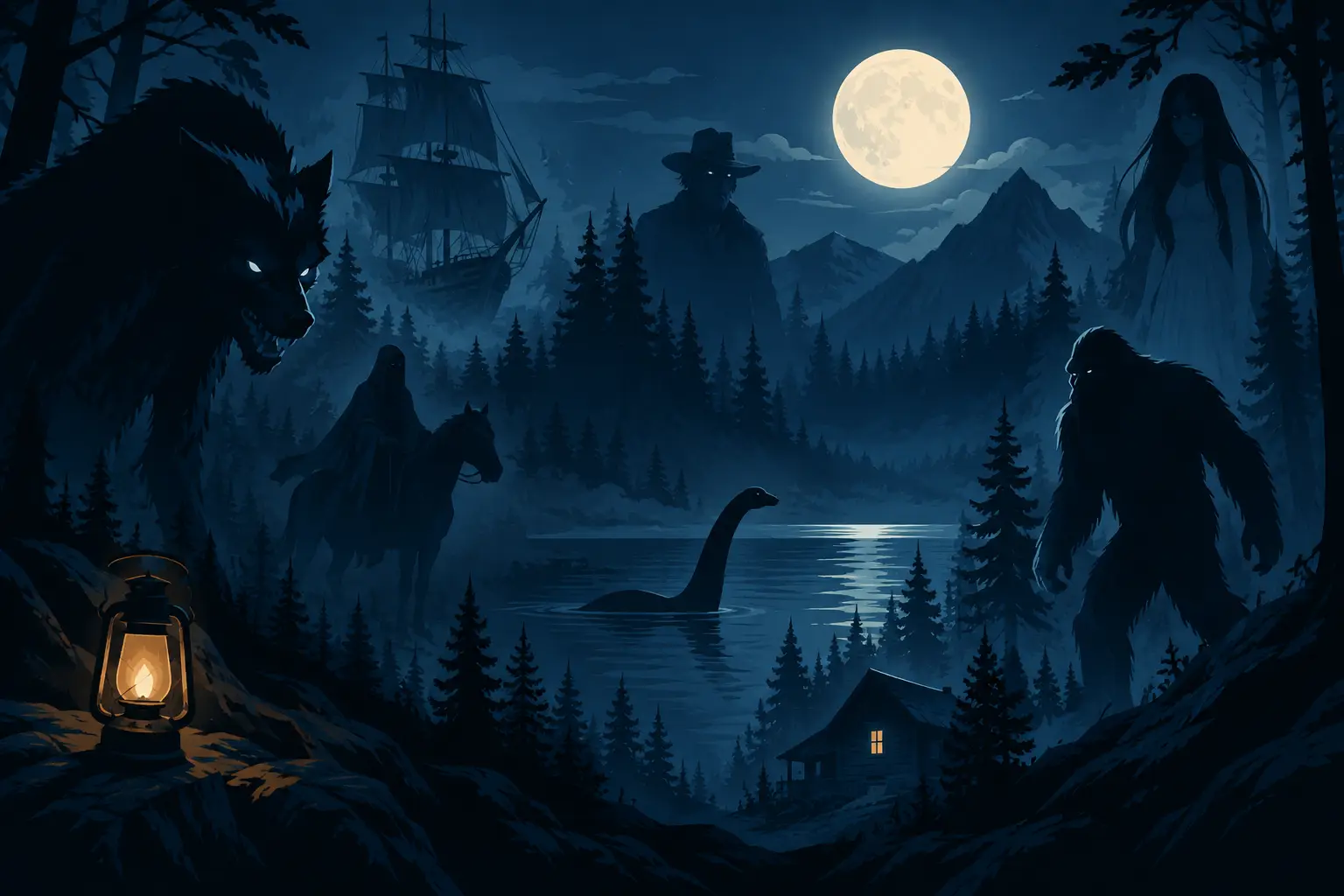
Some legends live in newspapers, others in campfire warnings, roadside signs, and the one story every local swears happened to a cousin. The top American legends are not simply famous monsters. They are regional personalities, shaped by dark woods, lonely highways, old disasters, and the stubborn belief that the map still has strange corners.
A creature becomes legendary when it belongs somewhere. Bigfoot belongs in the wet, towering forests of the Pacific Northwest. The Jersey Devil belongs in the Pine Barrens. The Mothman belongs beneath the rusting shadow of Point Pleasant. Their stories change with every retelling, but their sense of place is the whole point.
What Makes the Top American Legends Last?
A great American legend does more than scare people. It gives a region a creature of its own. It can be a warning, a prank, a way to explain something unknown, or a local badge of honor. Often, it is all of those things at once.
That is why a list of "top" legends can never be final. Fame is not the same as folklore value. A monster with decades of blockbuster attention may be less meaningful to a community than a little-known thing said to stalk one county road. The best way to meet these creatures is not as entries in a monster contest, but as residents of a weird and wonderfully haunted America.
A Field Guide to Top American Legends
Bigfoot, the forest giant
No creature looms larger over American cryptid culture than Bigfoot. Reports of huge, hair-covered, humanlike figures stretch across North America, but the modern legend is especially rooted in the Pacific Northwest. Rain-heavy forests, deep mountain terrain, and vast stretches of public wilderness give the story room to breathe.
Bigfoot endures because the creature carries a thrilling possibility: that something enormous could exist just beyond the trail. It is part wilderness guardian, part prankster, and part reminder that the woods do not belong entirely to us.
The Mothman of West Virginia
In 1966, Point Pleasant, West Virginia, became the center of eerie reports about a winged figure with glowing red eyes. Sightings clustered near the abandoned TNT area, a landscape already strange enough to feel staged by the unknown. The legend became forever tied to the 1967 collapse of the Silver Bridge, turning the Mothman into an omen in the public imagination.
Whether viewed as a warning spirit, a misidentified animal, or a perfect piece of modern folklore, Mothman has real staying power. Few creatures feel so completely fused to one city and one unsettling chapter of American history.
The Jersey Devil of the Pine Barrens
The Jersey Devil is said to have wings, hooves, a horse-like head, and a scream fit to make travelers reconsider a midnight walk. Its origin story often points to the Leeds family and a cursed thirteenth child, though versions differ wildly. That variation is a feature, not a flaw. Folklore thrives when no one version can lock the door on the others.
The Pine Barrens give the creature its electricity. This is a vast, wooded, sandy region tucked inside one of the nation’s most crowded states. The Jersey Devil proves that wilderness does not need to be remote to be haunted.
The Bell Witch of Tennessee
Not every American legend needs claws or feathers. The Bell Witch is a haunting, a voice, and an endlessly retold Tennessee tale centered on the Bell family in the early 1800s. Accounts describe knocks, attacks, strange noises, and a spirit that spoke openly to visitors.
The Bell Witch remains powerful because it turns the familiar into the frightening. A farmhouse, a family, and a patch of rural land become the stage for something that will not leave. It is less a creature story than a reminder that folklore can move into the house with you.
The Chupacabra of Puerto Rico and the Southwest
The chupacabra first surged into popular culture through Puerto Rican reports in the 1990s, where it was blamed for attacks on livestock. The original descriptions were uncanny and alien-looking. Later sightings in Texas and the Southwest often described hairless, canine animals, giving the legend a second American form.
That split matters. “Chupacabra” is not one fixed beast. It is a living label people have applied to different fears, sightings, and strange animals. Its journey from Puerto Rico into mainland folklore shows how quickly a legend can cross borders while changing shape.
The Ozark Howler
Deep in the Ozarks, people tell of a creature marked by its terrible cry. Descriptions vary: some say bear-like, some cat-like, some horned, and some simply say it is too ugly to name properly. The only dependable detail is the sound, a howl that belongs nowhere near a quiet ridge after dark.
The Ozark Howler is a fine example of regional folklore at its most elastic. It may not have the celebrity of Bigfoot, but it has the atmosphere: thick woods, steep hollows, and a noise that turns a familiar landscape into a place you suddenly do not want to be.
The Flatwoods Monster
West Virginia earns another place in the strange record with the Flatwoods Monster. In 1952, witnesses reported a towering figure after seeing an object streak across the sky. The creature was described with a glowing face, clawed hands, and a wide, hood-like shape.
The Flatwoods Monster sits at the crossroads of cryptid lore and UFO lore. Its story has been debated for decades, with explanations ranging from misidentified wildlife to mass panic. But the image remains unforgettable: a silhouette from another world standing at the edge of a West Virginia field.
The Fresno Nightcrawler
The Fresno Nightcrawler barely looks like a creature at all. It is often described as a pale, slender figure with long legs and little visible body, captured in eerie nighttime footage from California’s Central Valley. Its oddness is exactly its strength.
Unlike older legends born from a single family tale or a frontier newspaper, the Nightcrawler belongs to the age of grainy video and internet folklore. It proves new American legends are still being made, shared, questioned, and adopted by people who cannot stop staring at something they cannot explain.
The Skunk Ape of Florida
Florida’s answer to Bigfoot is the Skunk Ape, a swamp-dwelling, ape-like creature known for its overwhelming smell. Sightings center on the Everglades and other humid, tangled parts of the state where water, sawgrass, and shadows can play tricks on anyone.
The Skunk Ape is wonderfully Floridian. It is loud, humid, elusive, and a little ridiculous in the best possible way. That local flavor is why it deserves more than a footnote in Bigfoot lore.
The Loveland Frog of Ohio
The Loveland Frog is said to be a large, upright frog-like being seen near the Little Miami River in Ohio. Reports gained attention in the 1950s and again in the 1970s, when a police officer described an unusual creature by the roadside. It is a strange little legend with a huge personality.
This is proof that monsters do not need to be towering or terrifying to last. Sometimes a legend survives because it is so specific, so peculiar, and so impossible to forget.
The Goatman of Maryland
Maryland’s Goatman lurks in local lore as a half-man, half-goat terror tied to back roads and suburban edges. Some versions call it an escaped experiment. Others make it a wild hermit, a murderer, or a figure born from teenage dares and whispered warnings.
Goatman stories reveal another truth about American folklore: suburbia can make monsters too. A creature does not need an ancient mountain range when it has a bridge, a dark trail, and generations of locals daring one another to go looking.
The Kushtaka of Southeast Alaska
The Kushtaka, often described in English as an otter-like land being, belongs to the traditional stories of the Tlingit people of Southeast Alaska. It is associated with the dangerous edge between land and water, and in some tellings it can deceive, transform, rescue, or carry people away.
This legend deserves care. Indigenous stories are not generic cryptid inventory, and they should not be stripped from the living cultures that hold them. Meeting a legend respectfully means learning its regional and cultural context, not flattening it into a spooky mascot.
Collect the Story, Not Just the Monster
The creatures that haunt American folklore are better when they keep their accents. A Mothman without Point Pleasant, or a Jersey Devil without the Pine Barrens, loses the part that makes it unforgettable. Fablins was built around that truth: 50 states, 50 legends, each creature carrying a piece of the place that imagined it.
When you encounter a new legend, ask what landscape made it possible. Ask who tells the story, what it warns against, and why it still gets repeated. Then listen closely the next time a local says there is something strange out past the last streetlight.