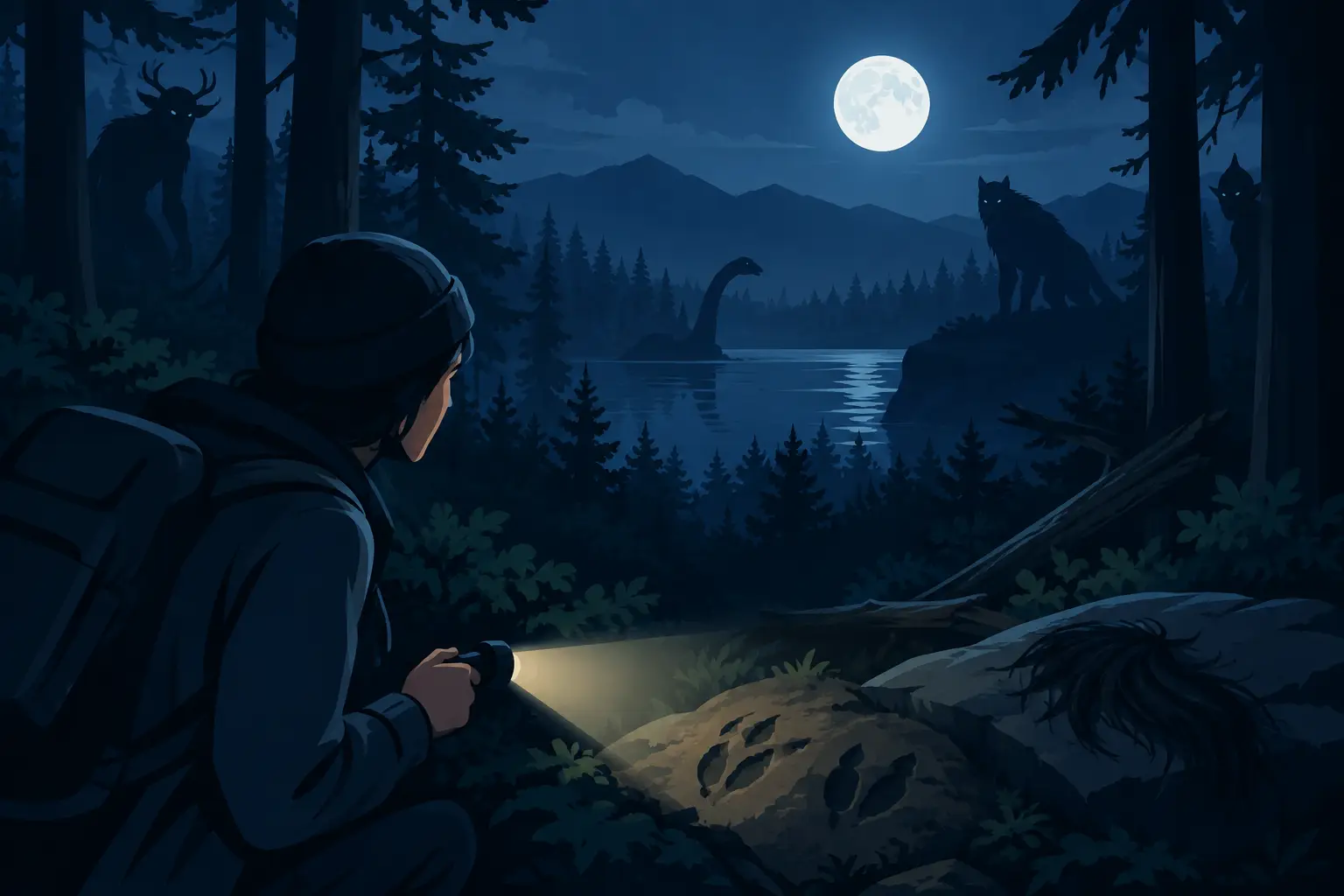
A strange sound in the woods is not automatically a monster. A pair of glowing eyes beside a back road is not automatically a warning. But when a story keeps returning to the same creek bend, mining town, mountain pass, or patch of swamp, it may be time to identify folklore creatures by more than a vague silhouette.
America’s legendary creatures are rarely defined by one dramatic trait. Their real signatures live in the details: where they appear, who tells the story, what they want, and what feeling they leave behind. Learn to read those clues and every regional tale becomes stranger, sharper, and a lot more memorable.
Start With the Creature’s Territory
The first question is not, “What did it look like?” Ask, “Where does this thing belong?” Folklore creatures are rooted in place. A legend that thrives in a Pacific Northwest rainforest carries a different kind of mystery than one born in a Louisiana bayou or along a frozen Great Lakes shore.
Terrain shapes the creature. Swamps produce hidden movement, murky water, and things that may be watching from reeds. Mountains create isolation, impossible echoes, and figures glimpsed at a distance. Desert legends often involve heat, missing time, strange lights, or a dangerous road with no one else on it. Coastal stories carry storms, shipwrecks, fog, and the uneasy sense that something came ashore.
That does not mean every hairy creature is a forest giant or every water monster belongs to a lake. It means habitat is your first filter. A creature that supposedly stalks old railroad lines, for example, may be tied as much to labor history and local tragedy as to its claws or glowing eyes.
Identify Folklore Creatures by Their Behavior
A creature’s habits are often more revealing than its appearance. Descriptions change as stories pass from porch to campfire to message board. Behavior tends to endure.
Does the creature lure travelers off the road? Guard a particular place? Knock on doors? Mimic voices? Steal livestock? Punish greed? Haunt people who break a local rule? Those patterns tell you what role it plays in its community.
A warning creature is different from a trickster. A guardian is different from a predator. Some legends exist to keep children away from deep water, abandoned structures, or dangerous woods. Others give shape to a shared fear after a disaster, a crime, or a stretch of bad luck. The creature may be terrifying, but the story is usually doing more than trying to scare you.
Watch for four especially useful behavioral clues:
- The warning: It appears before storms, deaths, accidents, or disappearances.
- The boundary: It punishes trespassers, night wanderers, or people who enter a forbidden place.
- The trick: It imitates a voice, creates misleading lights, or leads witnesses in circles.
- The hunger: It stalks, attacks, feeds, or leaves physical evidence behind.
Many creatures overlap. A lake monster can be both a warning and a hunger story. A spectral animal can guard a place while also leading the lost farther into danger. Folklore does not always sort itself into neat field-guide categories, and that is part of the fun.
Treat Appearance as a Clue, Not a Verdict
Horns, wings, red eyes, shaggy fur, impossibly long limbs: these traits grab attention, but they can also mislead. The same feature appears across many regions because people use familiar images to describe unfamiliar fear.
Instead of stopping at “it looked like a goat-man,” look for the combination. Was it seen near a specific bridge? Did it have hooves, a human voice, or a habit of chasing cars? Was it a physical animal, a ghostly figure, or something witnesses only heard? A single trait makes a creature broad. Several repeating details make it distinct.
Be careful with modern retellings, too. Posters, movies, and internet art can give a legend one standard look even when older accounts disagree. That image may be excellent monster design, but it is not automatically the oldest or most local version of the creature. A good creature hunter leaves room for variations.
Follow the Story Back to the Community
The best way to identify a folklore creature is to learn who has kept its story alive. Is it a family tale? A camp legend? A story told by hunters, dockworkers, students, or people in one small town? The answer reveals what the creature means.
Some stories belong to long-standing cultural traditions and deserve care rather than casual costume treatment. Native stories, in particular, are not a grab bag of spooky characters for outsiders to rename, remix, or flatten into generic cryptid content. If a being is sacred, restricted, or tied to living community knowledge, the respectful move is to listen to the people connected to that tradition and accept that not every story is ours to collect or repeat.
Other legends evolve openly through local newspapers, roadside rumors, schoolyard dares, and late-night radio. These tales can have dozens of versions, each one carrying the voice of its teller. Contradictions do not ruin the legend. They show it is still alive.
Separate the Legend From the Evidence
Folklore is not a courtroom, and it does not need proof to matter. Still, it helps to know whether you are looking at a traditional story, a modern sighting report, a hoax, an animal misidentification, or a blend of all four.
Tracks can be weathered prints. A scream can be a fox, bobcat, bird, or something mechanical moving through the dark. Reflections turn ordinary eyes into a supernatural glare. None of that makes a local legend boring. It explains why strange places produce strange reports - and why a story can grow around a real sound, animal, or accident.
The sweet spot is curiosity without gullibility. Ask what a witness saw, but also ask what they heard before they saw it, what conditions were present, and whether the account matches older local patterns. You can respect the mystery without claiming certainty where there is none.
Build a Creature Profile
When you encounter an unfamiliar American legend, make a compact profile. Give it a home state or region, a preferred habitat, its most repeated behavior, its signature physical detail, and the kind of story it belongs to. Is it a roadside warning? A forest encounter? A haunted-water tale? A creature born from a regional disaster?
This simple method makes comparisons easier. Two creatures may both have wings, but one might be an omen tied to a small Appalachian community while the other is a nocturnal predator reported around desert caves. Their shapes may rhyme. Their legends do not.
It also makes collecting more meaningful. A figure on a shelf becomes more than a cool little monster when you know its map, its mood, and the people who gave it a name. That is the spirit behind Fablins: 50 states, 50 legends, and a whole country full of creatures that refuse to be generic.
Let the Details Keep Changing
No two tellings of a living legend are perfectly alike. Your grandfather’s creature may have yellow eyes; your neighbor swears they were red. One account says it ran on four legs, another says it stood like a person. Rather than forcing every version into a single official answer, notice what remains when the details shift.
Maybe it always appears near the same waterway. Maybe it always arrives before misfortune. Maybe every witness comes home with the same feeling: they were not alone out there.
That is the clue worth carrying with you. Listen for the place, the pattern, and the people behind the tale. The next time America’s shadows produce a familiar shape, you may not know exactly what you saw - but you will know which legend has started following you home.