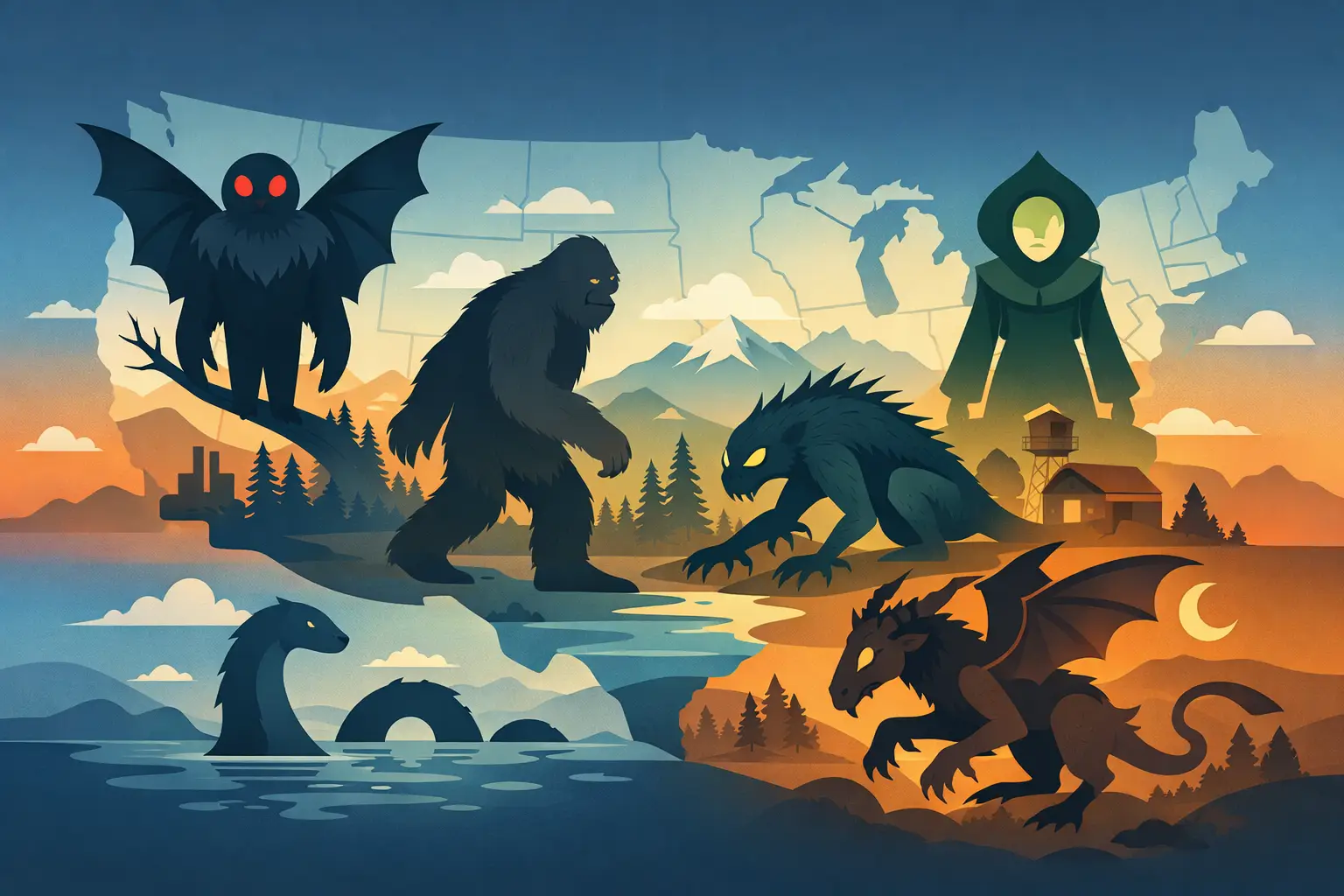
A creature does not need fangs, wings, or glowing red eyes to become unforgettable. It only needs a place to belong. American folk monsters live in pine barrens, abandoned mines, river bottoms, mountain passes, and the uneasy space beyond a town’s last porch light. They carry the accent, anxieties, jokes, and warnings of the people who tell their stories.
That is what makes them more than generic monsters. A regional legend is a map with teeth. It tells you where not to wander, what kind of weather to fear, which old road has a reputation, and why the woods behind your grandparents’ house never felt entirely empty.
What Makes a Monster a Folk Monster?
A folk monster is not defined by a laboratory specimen, a movie studio, or a single official origin story. It grows through retelling. One witness sees something impossible. A neighbor adds a detail. A newspaper makes it stranger. A campfire turns it into a warning. After enough years, the creature belongs to the region as surely as a local landmark.
Some American legends began as tall tales, built for lumber camps and railroad towns where exaggeration was practically a sport. Others came from Indigenous traditions, immigrant storytelling, religious fears, unexplained animal encounters, or real tragedies that communities struggled to explain. Many have changed shape as they passed from one generation to the next.
That messy history is part of the magic, but it calls for care. Not every story is open for anyone to remix without context. Some creatures are tied to living cultures and sacred traditions. The best way to meet folklore is with curiosity rather than entitlement: learn where a story comes from, listen to the people connected to it, and resist flattening every legend into the same spooky mascot.
American Folk Monsters Are Regional Memory
The Jersey Devil is impossible to separate from New Jersey’s Pine Barrens. Its usual description is a glorious nightmare - horse-like head, leathery wings, hooves, claws, and a scream that makes the dark feel much larger. The legend has been told in many forms, often connected to the Leeds family and colonial-era local history. Whether someone treats it as a cryptid, a cautionary tale, or a bit of hometown mischief, its power comes from the place beneath it: miles of scrubby woods and winding roads where anything might be moving just beyond the headlights.
In Wisconsin, the Hodag wears its lumberjack-country origins proudly. Early descriptions gave it horns, claws, a reptilian body, and a grin fit for a creature that knows it has already become famous. The Hodag’s story was famously promoted as a hoax in the 1890s, yet that did not kill the legend. It gave the beast a second life. Today, it proves that folklore does not require literal belief to thrive. A monster can be invented with a wink and still become a genuine symbol of local identity.
West Virginia’s Mothman carries a different kind of chill. Reports from the 1960s described a towering winged figure with shining eyes near Point Pleasant, while the area was also shaken by the tragic collapse of the Silver Bridge. Over time, the creature became entangled with grief, omen-making, UFO lore, and paranormal fascination. The details are debated, as they should be. But the legend endures because it gives form to a feeling many people recognize: the sense that something was wrong before anyone had words for it.
Then there are the monsters born from the cheerful absurdity of frontier storytelling. The Slide-Rock Bolter of the American West was said to cling to steep mountainsides, lubricate its path with saliva, and rocket downhill with its jaws open to swallow unsuspecting tourists. It is ridiculous on purpose. Lumberjack and frontier tall tales often made nature enormous, hungry, and funny, transforming dangerous landscapes into stories people could laugh about around the fire.
Why Every State Has Room for a Legend
Folklore is local because fear is local. Coastal communities imagine what rises from black water. Mountain towns tell stories about what calls from a ridge. Desert legends make room for heat, distance, and lights that should not be there. In farm country, a creature may stalk lonely roads or circle a field after midnight.
The monster changes because the landscape changes. A winged omen makes sense in a river town where fog rolls in low. A shaggy brute belongs naturally in a cold northern forest. A strange little goblin fits a swamp or cave system better than a broad prairie. Geography gives a legend its stage directions.
Local history matters just as much. American folklore holds the marks of migration, industry, conflict, disaster, and changing technology. A beast might emerge from railroad rumors, logging-camp humor, mining dangers, colonial gossip, or a run of strange newspaper reports. These stories are not museum pieces sealed behind glass. They keep adapting because communities keep finding new reasons to tell them.
That makes a state-by-state collection more interesting than a shelf full of interchangeable creatures. A figure tied to a specific legend can carry a whole atmosphere with it: the terrain, the era, the rumor, the odd detail only locals remember. It becomes a little monument to the weirdness of a place.
The Difference Between a Cryptid and a Folk Monster
The two terms overlap, but they are not identical. A cryptid is generally an animal or creature that some people believe may exist despite lacking accepted scientific evidence. Bigfoot, lake monsters, and unknown wild beasts often fall into that category. The focus is frequently on the question: could it be real?
A folk monster has a wider job. It may be a cryptid, but it can also be an omen, a trickster, a tall-tale beast, a ghostly presence, or a creature everyone knows is impossible. Its value is not limited to proof. The better question is often: why did this creature matter enough for people to keep telling its story?
The Hodag works beautifully as an example. Its roots include an admitted hoax, but that does not make it less folkloric. The legend took hold because people embraced it. It became part of the regional imagination. Meanwhile, some cryptid sightings may remain intensely personal and uncertain without ever growing into a shared local myth.
For collectors, that distinction opens a much stranger cabinet of curiosities. You are not restricted to the usual handful of famous beasts. You can make room for sly cave-dwellers, oversized lumber-camp predators, roadside terrors, and creatures that only haunt one corner of one state.
Collecting Legends Without Sanding Off Their Edges
A great monster figure starts with more than a silhouette. The strongest designs preserve the feature that makes a legend unmistakable. Maybe it is a strange gait, a specific set of horns, a weathered regional color palette, or an expression that feels equal parts threatening and mischievous. The goal is not realism at all costs. It is recognition.
There is a trade-off, of course. A figure needs a bold, readable shape from across a shelf, while folklore is often contradictory. One account gives a creature feathers; another gives it fur. One storyteller insists it is ten feet tall; another says it fits under a porch. Good character design does not pretend those conflicts do not exist. It chooses a version with intention and leaves room for the legend to stay wild.
Context matters, too. A creature becomes richer when its name, home state, and core story travel with it. A collector may first choose a legend from a home state, then chase the monsters connected to road trips, family roots, or a favorite eerie corner of the country. Fablins brings that idea into focus with a simple promise: 50 states. 50 legends.
Keep the Local Weird
The most exciting American folk monsters are often the ones that have not been polished into national celebrities. They are the creatures with three conflicting origin stories, the ones remembered by a mural, a festival, an old postcard, or one person’s unnerving story about the woods.
So ask around when you travel. Check the name of the creek, the mountain, the swamp, or the old mine. Notice the creature on the town sign. Listen when someone says, half-jokingly, that you should not take that road after dark. America’s legendary creatures are still out there, waiting in the details.