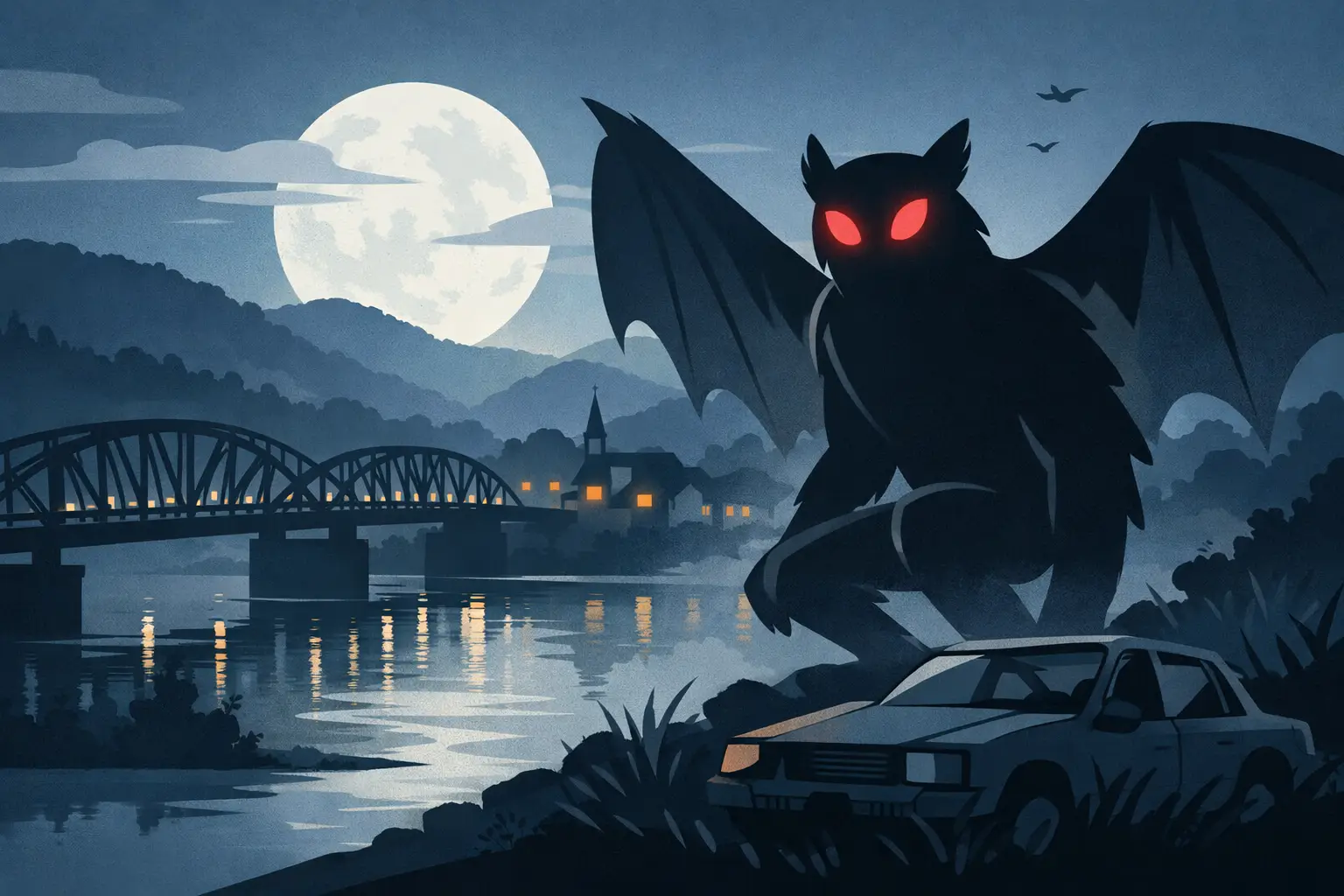
A winged shape in the headlights. Two red eyes at the edge of an abandoned munitions site. Then, a disaster so devastating that the creature and the tragedy became permanently tangled together. Mothman legend facts are stranger than a simple campfire story because the legend grew from real witnesses, a real town, and one of America’s most painful bridge disasters.
The truth is not that Mothman has been proven to exist. It is that Point Pleasant, West Virginia, experienced a concentrated burst of unnerving reports between 1966 and 1967, and the story has kept changing ever since. Separating the record from the retellings makes the legend more fascinating, not less.
Mothman Legend Facts Begin in the TNT Area
The Mothman story is most often traced to the night of November 15, 1966. Four young Point Pleasant residents - Roger Scarberry, Linda Scarberry, Steve Mallette, and Mary Mallette - were driving near the abandoned World War II munitions complex outside town. Locals called it the TNT area. Its concrete igloos, overgrown roads, and industrial ruins were already the kind of place where a flashlight beam could make ordinary things look wrong.
The group reported seeing a large gray figure with glowing red eyes near the road. They described it as human-shaped, with wings, and said it pursued their car as they drove away. Their account was reported to local authorities and soon reached the newspaper. That reporting matters: the encounter was not invented decades later for a movie or a souvenir shop.
Still, “reported” is not the same as “verified.” No physical evidence established that a giant winged humanoid was present that night. The original descriptions also varied in details, as eyewitness accounts often do during a frightening event. What can be said with confidence is that four people believed they had seen something extraordinary, and their fear set a local mystery in motion.
The sightings did not stop with one carload of witnesses
Over the following year, other residents around Point Pleasant described strange lights, unsettling encounters, and a large flying figure. Some accounts involved red eyes. Others emphasized a broad wingspan, unusual speed, or the sense that something was watching from the darkness.
These stories did not all describe the exact same creature. That is one reason the Mothman legend resists easy classification. Some witnesses may have seen a bird. Some may have encountered lights, shadows, or the unnerving atmosphere of the TNT area. Some stories were likely reshaped as they passed from neighbor to neighbor. Yet the number of reports gave the town a shared monster, and that shared monster gained a name.
The name “Mothman” was reportedly inspired by the Batman television series, which was hugely popular at the time. It was catchy, comic-book strange, and far more memorable than “large winged thing seen near the old munitions plant.” Once the name landed, the creature could become a character.
The Silver Bridge Is the Legend’s Darkest Fact
On December 15, 1967, the Silver Bridge collapsed during evening traffic, sending vehicles into the Ohio River between Point Pleasant and Kanauga, Ohio. Forty-six people died. It remains the central tragedy attached to the Mothman story.
The collapse was real, sudden, and horrifying. But the evidence does not show that Mothman caused it, predicted it, or warned the town in any confirmed supernatural way. Later investigations found a structural failure in an eyebar of the bridge’s suspension chain. A small defect and corrosion-related damage contributed to a catastrophic failure in a structure that lacked modern redundancy.
That distinction deserves care. The people lost in the collapse were not props in a monster tale. The disaster led to major changes in bridge inspection and safety standards, making its real-world legacy far bigger than folklore. Treating it only as a spooky plot twist flattens a human tragedy.
So why did Mothman become linked to the bridge? Timing. The sightings had been circulating for roughly 13 months when the bridge fell. In the aftermath, a frightened community naturally looked for a pattern. A strange creature seen before a catastrophe is an irresistible piece of folklore logic: perhaps it was an omen, perhaps it was a warning, perhaps it was drawn to disaster.
Those are powerful interpretations. They are not established facts.
Was Mothman a bird?
One of the most practical explanations is misidentification. Large birds, especially sandhill cranes, can appear enormous in poor light. They have wide wingspans, long legs, and reddish markings around the eyes. An unexpected bird rising from roadside brush could create a deeply unsettling silhouette, especially for witnesses already moving through a dark, isolated landscape.
That explanation fits some reports better than others. It also does not settle every account, because memories, secondhand stories, and later embellishments make the full collection of sightings impossible to reconstruct with scientific precision. A bird explanation is plausible, not a time machine.
The stronger claim is simpler: no confirmed evidence requires a supernatural creature to explain the events. The more interesting claim is that an ordinary animal, a scary place, and a community under stress can become the raw material for an extraordinary regional legend.
How John Keel Turned Reports Into Mythology
Writer John Keel arrived in Point Pleasant while the sightings were still fresh. He collected witness stories and connected them to a much broader web of paranormal ideas: strange lights, possible UFOs, prophetic dreams, mysterious phone calls, and the shadowy “Men in Black.” His 1975 book, The Mothman Prophecies, helped transform a local West Virginia story into a national mystery.
Keel’s version is essential to Mothman culture, but it should not be read as a police file. He wrote with a fascination for patterns, high strangeness, and the possibility that seemingly unrelated events were connected. His work preserved stories that might otherwise have faded. It also encouraged readers to see Mothman as more than a creature in the woods.
That is where many modern Mothman legend facts get blurred. The 1966 witness reports are one layer. Keel’s paranormal framework is another. Films, podcasts, artwork, online lore, and festival retellings add still more layers. A version that feels ancient or definitive may actually be a detail popularized decades after the original sightings.
Why Point Pleasant Still Belongs to Mothman
Mothman endures because it is not just a monster. It is a creature rooted in a particular American place: river fog, rusting industrial ruins, Appalachian roads, small-town memory, and the uneasy feeling that history has left something behind in the trees.
Point Pleasant has embraced that identity with a statue, a museum, and the annual Mothman Festival. That does not mean the town claims a supernatural case has been solved. It means the legend has become part of local culture, bringing together longtime residents, cryptid hunters, artists, and curious travelers who want to stand where the story began.
For collectors and folklore fans, Mothman also proves that a regional creature can grow into a national icon without losing its hometown shadow. The best cryptid stories carry a map inside them. You can picture the road, the river, the old TNT bunkers, and the people who first tried to explain what they saw.
The next time someone says Mothman predicted the Silver Bridge collapse, the most honest answer is: that is part of the legend, not part of the proof. But do not mistake uncertainty for emptiness. The documented fear, the real disaster, and the folklore that followed are enough to make Mothman one of America’s most haunting creatures. Give the story its proper place: not in a lab specimen jar, but in the strange, living bestiary of American regional lore - where Fablins believes every state still has something waiting in the dark.