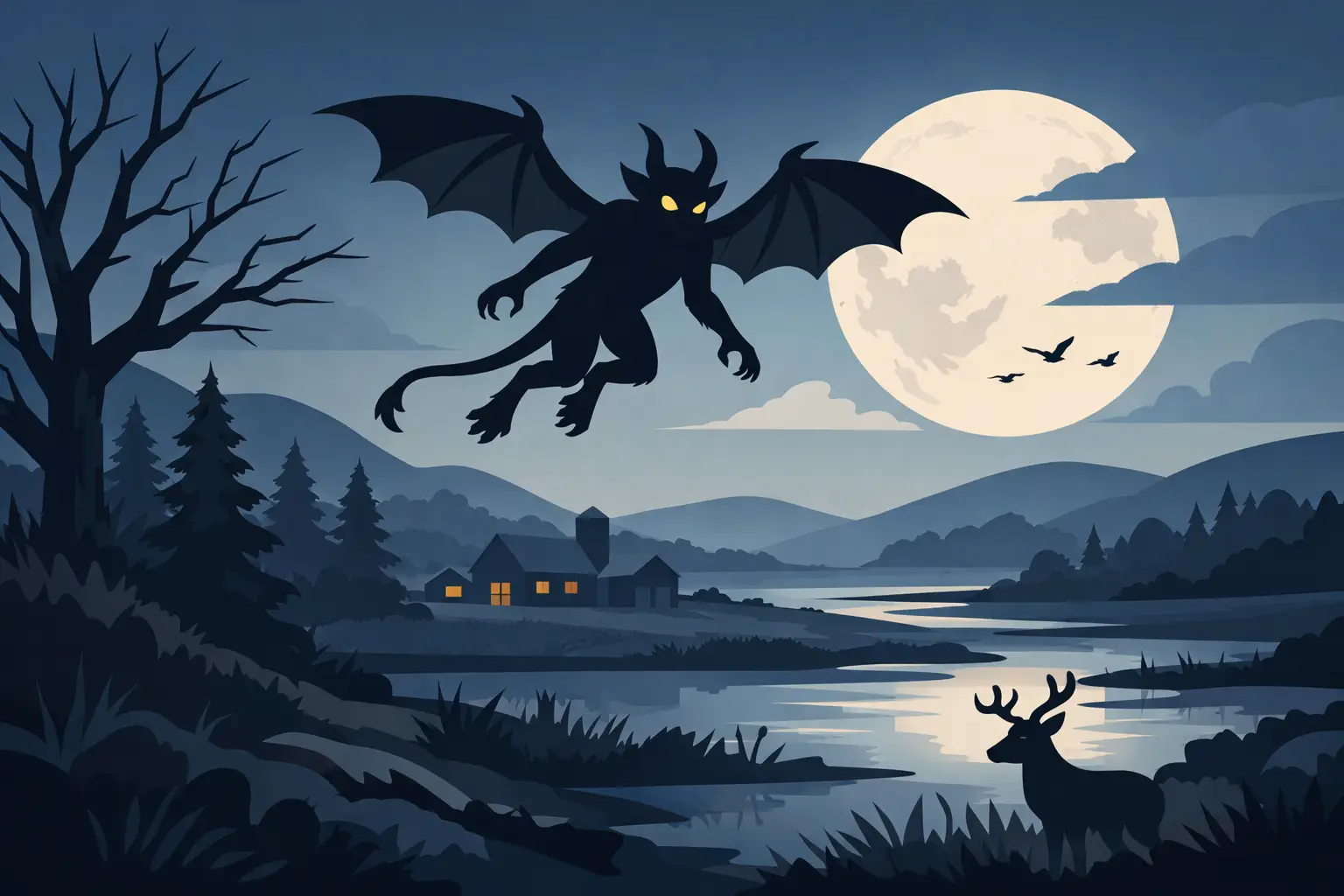
A scream cuts across the Pine Barrens. Something with wings slips over a frozen road. Hooves, claws, a horse-like head, a bat-like body - every witness seems to catch a different nightmare in the dark. That is the enduring charm of Jersey Devil sightings history: it is not one neat monster story. It is three centuries of rumor, regional identity, newspaper frenzy, and people trying to name what they thought they saw.
The Jersey Devil belongs to New Jersey, especially the vast, sandy woodland of the Pine Barrens. The creature is often pictured with a goat or horse head, leathery wings, horns, cloven hooves, and a forked tail. But that familiar silhouette came together slowly. The oldest parts of the legend, the most famous sightings, and the modern monster all come from different moments in American history.
Before the Monster Had a Name
The most repeated origin story begins with Mother Leeds, a colonial-era woman said to have given birth to her thirteenth child in 1735. Depending on the telling, she curses the baby in frustration, calls it a devil, or receives a curse for some earlier sin. The child transforms, sprouts wings, flies up the chimney, and vanishes into the woods.
It is a great campfire tale. It is also not a clean piece of eighteenth-century documentation.
Historians and folklore researchers have connected the Leeds name to Daniel Leeds, a real colonial printer, surveyor, and political writer. Leeds drew controversy for his almanacs, which included astrology and ideas that offended powerful Quaker leaders. His family also had political conflicts with Benjamin Franklin, who mocked Leeds descendants and their almanacs. In that setting, calling the family associated with Leeds "devilish" could function as a sharp political insult rather than a claim that a winged child haunted the woods.
This does not mean someone invented the Jersey Devil from nothing on a single afternoon. Folklore rarely works that way. Old European fears, religious arguments, local grudges, strange animal reports, and the isolation of South Jersey likely mixed together over generations. The Mother Leeds birth story may preserve pieces of those conflicts, but its polished version is much newer than the date it claims.
Jersey Devil Sightings History Takes Flight
By the nineteenth century, reports of an odd winged creature were circulating in southern New Jersey. Early accounts often used names such as the Leeds Devil or the Leeds Devil of the Pines. Descriptions varied wildly. One person saw a birdlike beast. Another saw something that leaped. Someone else heard an unplaceable cry.
That inconsistency is not a flaw in the legend. It is part of its engine. The Pine Barrens are a place where ordinary sounds can turn uncanny: foxes shriek, owls call, branches scrape in the wind, and roads disappear between dense stands of trees. A frightened witness does not need to see every detail for a story to grow teeth.
The Jersey Devil also arrived at the right time for newspaper culture. Sensational local stories sold papers, and a weird creature in the woods gave editors exactly what they needed: danger close to home, a monster with a memorable name, and enough uncertainty to invite tomorrow's update. Newspapers did not merely record the legend. They helped give it a standard shape.
The 1909 Panic
The defining chapter of Jersey Devil sightings history came in January 1909. For roughly a week, newspapers across New Jersey and nearby Pennsylvania carried a blizzard of reports. People claimed the creature crossed streets, attacked animals, left tracks, rattled at windows, flew over rooftops, and terrified factory workers. Schools and businesses reportedly reacted to the panic, while armed residents searched the countryside.
The details were too colorful to stay still. One account placed the creature in Camden, another in Bristol, Pennsylvania, and others deep in the Pines. Witnesses described wings, a long tail, hoofprints, a horrible screech, and a head that could look doglike, horse-like, or goat-like depending on the telling.
Some reports were likely jokes, misidentifications, or newspaper embellishment. A famous Philadelphia episode involved a supposed Jersey Devil displayed at a museum, later revealed to be a kangaroo altered with fake wings and other additions. The hoax was silly, but it tells us something important: people were hungry to see the monster for themselves.
That does not make 1909 uninteresting. Quite the opposite. It shows a legend becoming public property. The Jersey Devil was no longer only a shadowy regional warning. It had become a shared spectacle, a creature people could argue about at breakfast, fear on the walk home, and recognize instantly in a headline.
Why the Pine Barrens Made the Perfect Lair
A monster needs a map. The Jersey Devil has one of the best in American folklore.
The Pine Barrens cover a huge stretch of southern New Jersey, with sandy soil, cedar swamps, pine forests, and roads that can feel far from civilization even when towns are not far away. For generations, outsiders treated the region as remote and strange. Residents were sometimes unfairly caricatured as "pineys," a label tied to class prejudice and the idea that the Pines held people and customs apart from the rest of the state.
The Jersey Devil absorbed that outsider anxiety. It became a warning about the woods, but also a symbol of the woods refusing to be tamed or explained. This is why the creature feels bigger than a simple animal sighting. It carries the atmosphere of a place where the landscape itself seems to be keeping a secret.
The legend has trade-offs, too. Its wild popularity can flatten the real Pine Barrens into a generic spooky backdrop. The stronger version of the story remembers that this is a living region with communities, ecology, history, and its own voice. The Devil is most compelling when it stays rooted there.
What People May Have Seen
There is no verified physical evidence that a single horned, winged creature has survived in the Pine Barrens since colonial times. That is the plain answer. But a lack of proof does not erase the reasons sightings happen.
Misidentified wildlife is one possibility. Sandhill cranes, herons, owls, and large birds can look bizarre in bad light, especially when their calls are unfamiliar. Escaped or injured animals can produce even stranger impressions. Hooflike tracks may come from ordinary animals, altered ground, or an eager person with a prank in mind.
Then there is expectation. Once a community knows a monster story, an unexplained sound has a ready-made name. This is not necessarily dishonesty. Memory is creative under pressure. A fast glimpse becomes a fuller shape when someone retells it, and each retelling borrows details from the version everyone already knows.
Still, treating every witness as a fool misses the point. Folklore is not a failed science report. It is a record of what unsettles a place, what people pass along, and what refuses to leave the local imagination.
The Devil Never Really Left
After 1909, sightings continued in waves. Reports appeared through the twentieth century, and the Jersey Devil moved into postcards, comics, sports culture, haunted attractions, and roadside souvenirs. Every new appearance changed the creature a little. Sometimes it was a killer. Sometimes it was a prankster. Sometimes it was practically a mascot.
That flexibility is why it survives. Bigfoot has the deep woods. Mothman has bridge-town dread. The Jersey Devil has an entire state legend built from colonial gossip, newspaper hysteria, and the dark line of the Pines at night.
For collectors and folklore fans, this makes the Jersey Devil more than a famous cryptid. It is a reminder that America’s legendary creatures are not interchangeable monsters. Each one is shaped by a particular patch of ground and the people who kept talking after they heard something scream in the trees.
If you visit South Jersey, listen closely, but do not rush to turn every wingbeat into proof. Let the uncertainty do its work. The Jersey Devil has endured for centuries because the story leaves just enough room for the next witness to look up.