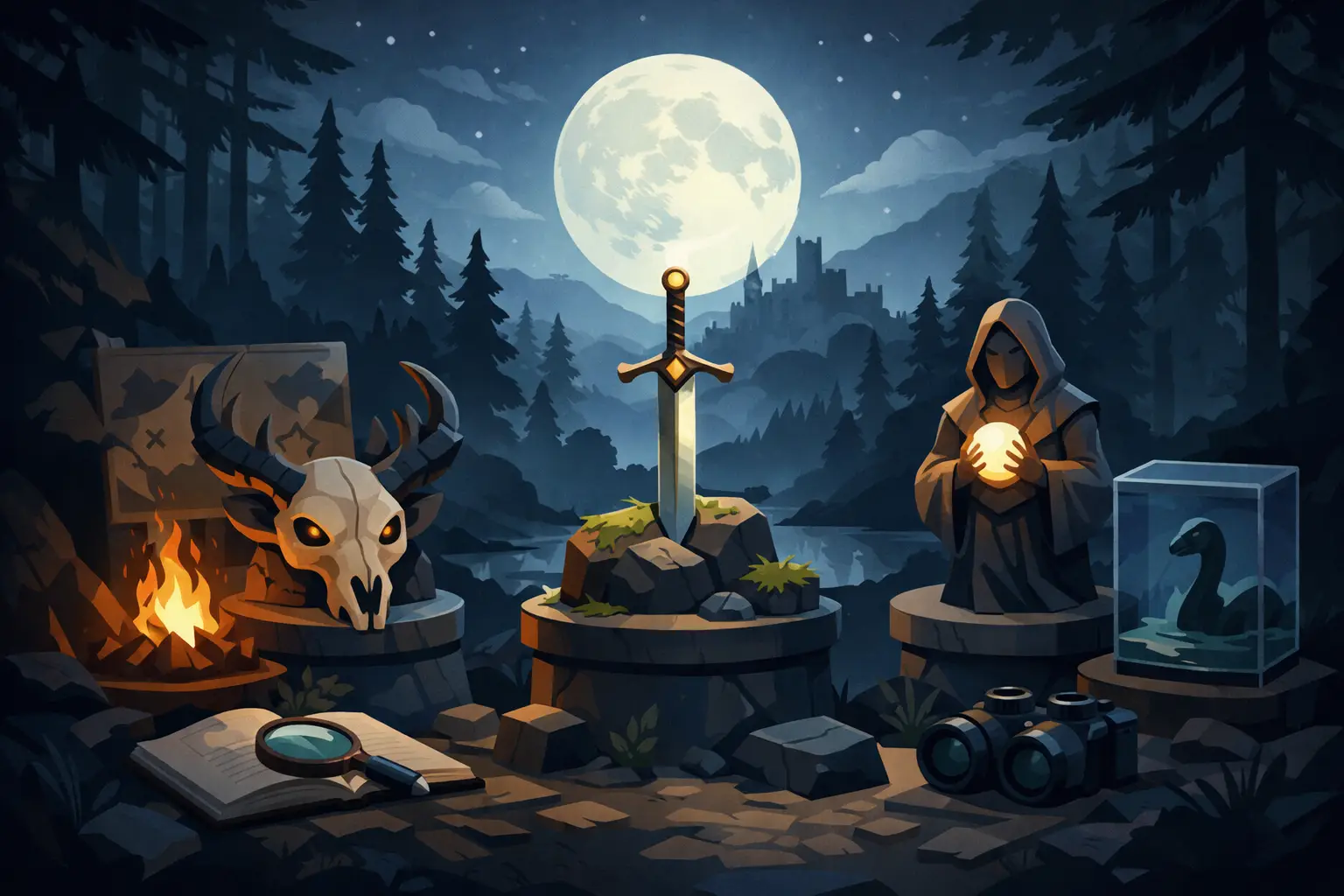
A map is more than state lines when you know what is said to be hiding beyond them. To build a regional legend collection is to give those stories a place on your shelf: swamp things, roadside beasts, haunted birds, lake monsters, and local nightmares with names that rarely make it into the mainstream monster aisle.
The best collections do not begin with the question, “What is rare?” They begin with, “What story do I want this display to tell?” For some collectors, that story starts at home. For others, it follows childhood road trips, a favorite campfire tale, or the weirdest creature ever reported in a state they have never visited. Either way, regional folklore gives every figure a reason to exist beyond looking cool under a display light.
Start With a State, Not a Shopping List
A regional legend collection gets its power from place. Pick one state that means something to you and begin there. It might be your home state, where you went to college, where your family gathers for the holidays, or the state that gave the world a creature too strange to ignore.
This approach keeps the collection personal. A shelf packed with generic monsters can be fun, but a shelf where every creature carries a piece of American geography has a different kind of charge. A legend from the Appalachian woods should feel different from one born near desert highways, Gulf marshes, Great Lakes shorelines, or Pacific Northwest timber country. The creature is only half the story. The landscape, witnesses, warnings, and local pride are the rest.
Do a little digging before you commit. Search old newspaper archives, local history books, regional museums, oral-history projects, and community stories. Pay attention to how people describe the legend. Is it a warning for children? A tall tale told at fishing camps? A creature blamed for livestock trouble? A spirit attached to a particular road, bridge, or abandoned place? Those details make a collection feel lived-in rather than assembled.
Choose Your Collection Rule
There is no single correct way to collect America’s legendary creatures. The fun is in creating a rule that gives your hunt shape. You can build by home states, travel states, creature type, region, or a full fifty-state mission.
A fifty-state collection is the grand expedition. It gives every new release a clear place in the larger display and turns completion collecting into a long-haul adventure. The trade-off is patience. Not every state has an equally famous legend, and the obscure ones are often the most rewarding precisely because they take more research to find.
A regional approach can be more focused. Maybe you collect only Southern swamp legends, Great Lakes oddities, desert apparitions, or creatures said to haunt the mountain states. This makes it easier to build a display with a shared mood, but it can also mean passing over a remarkable figure because it lives outside your chosen territory.
A personal-map collection is looser and often more meaningful. Choose figures connected to places you have lived, places you have visited, or places still waiting on your travel list. A creature becomes a souvenir of a real memory or a future destination. That is a much better reason to bring home a figure than chasing whatever happens to be loudest online.
Let the Folklore Set the Mood
Once you know your collecting rule, think about atmosphere. Regional legends are not interchangeable. A pale thing glimpsed along a foggy coastline belongs in a different world than a horned beast seen near a dusty fence line.
Build your display around that difference. Wood tones, old road maps, muted field-guide labels, postcard-style state cards, and small landscape details can help frame the figures without stealing the scene. You do not need to turn a shelf into a miniature museum. One well-chosen backdrop or a simple state outline can do more than a cluttered pile of props.
Color can help tell the story, too. Deep greens and muddy browns suit river creatures and forest stalkers. Rust, gold, and bone-white work for desert legends. Blue-gray shades give lake monsters and coastal hauntings a colder presence. The goal is not to make every section match. The goal is to make each creature look like it wandered in from somewhere specific.
Keep the display flexible if you are collecting over time. Legends have a habit of multiplying. A single state figure can lead to a neighboring-state creature, then a whole region, then a shelf that needs reinforcements. Leave room for the next sighting.
Build a Regional Legend Collection With Context
The difference between owning figures and building a collection is context. Give each creature a small identity card, even if it is just a handwritten note tucked behind the display. Include the state, the legend’s name, the area it is associated with, and one detail that makes the story memorable.
For a fuller collector record, track these four things:
- The state and the specific region connected to the legend
- The earliest version of the story you can find
- The details that change from one telling to another
- Why that creature earned a place in your collection
That last point matters. Folklore changes as it travels. Some legends have many names, shifting descriptions, and competing origin stories. That is not a flaw in the research. It is often the proof that the tale is alive. Avoid treating one internet summary as the final word, especially when a legend has roots in a real community, Indigenous tradition, or local history that deserves care and accurate credit.
A good collection can be eerie without flattening the story behind it. Make room for uncertainty. “Reported near,” “said to haunt,” and “known in local stories as” are sometimes more honest than pretending every legend arrives with a neat case file.
Collect for the Long Haunt
The most satisfying displays are built slowly. Set a budget, watch for planned releases, and decide whether you are a completionist, a selective curator, or somewhere between the two. There is no prize for buying everything immediately if it means the figures lose their connection to your own interests.
Figures released in waves create a natural rhythm. You can learn about each new creature, make space for it, and decide how it fits into your map before the next one appears. That anticipation is part of the experience. Fablins is built around that long view: 50 states, 50 legends, with each creature adding another strange landmark to a larger American folklore map.
Protect the figures you care about. Keep them away from prolonged direct sunlight, avoid crowded shelves where paint can rub, and save packaging if condition matters to you. But do not let preservation become an excuse to hide everything away. These creatures are made for display. Let them stare back at visitors. Let someone ask, “What is that?” Then tell them the story.
Make Room for the Weird States
Famous cryptids are easy entry points, but the real magic often waits in the lesser-known corners of the map. Every state has stories that stayed local because they were tied to one town, one mine, one stretch of water, or one unforgettable witness. Those are the legends that make people lean closer.
When you find a creature nobody in your circle recognizes, resist the urge to explain it away too quickly. A regional legend does not need national fame to matter. Its power may come from exactly how specific it is: a warning whispered near one creek, a shape seen beyond one tree line, a name that still makes locals glance toward the dark.
Start with one state. Give its creature a place, a story, and a little breathing room. The rest of the map will get stranger from there.