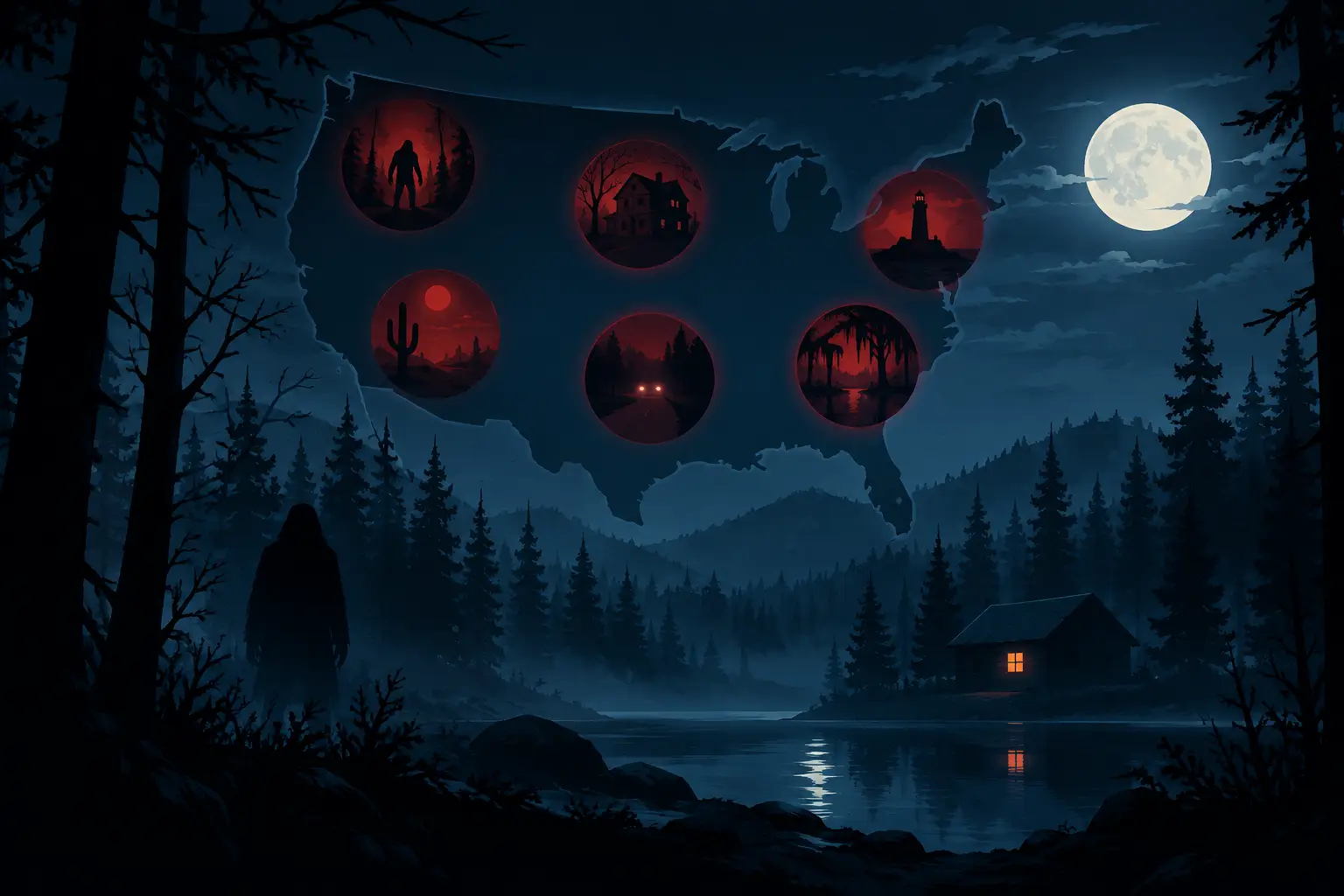
A monster in the middle of a cornfield does not scare the same way as a monster beneath black water. A pale figure on a desert highway carries a different charge than something knocking at a cabin door during a hard Appalachian rain. That is the power behind regional horror trends: the best American scares know where they live.
For years, mainstream horror often chased universality. The haunted house could be anywhere. The masked killer had no hometown worth naming. Now, audiences are hungry for creatures with mud on their boots, specific weather in their lungs, and a history tied to one crooked stretch of road. They want the thing their cousin swears they saw near the lake, the warning their grandparents repeated, the legend that belongs to one state and refuses to behave anywhere else.
Why Regional Horror Trends Feel So Alive
Regional horror is not simply horror with a map pinned to it. It is fear shaped by place. Local landscapes, industries, migration, religion, wildlife, and disasters all leave fingerprints on the creatures a community imagines.
A coastal legend may carry the unease of fog, wreckage, and water that will not give back what it takes. A Midwestern story may grow from endless fields, abandoned grain elevators, or lonely two-lane roads. In the Southwest, heat, distance, and ancient rock formations can make the unknown feel vast rather than hidden. The Pacific Northwest has rain, timber, deep forest, and the certainty that something could watch from ten feet away without ever being seen.
That specificity makes a legend memorable. Generic horror says, “Be afraid.” Regional folklore says, “Do not take that road after dark, and definitely do not stop near that particular bridge.” One is a mood. The other is an invitation.
Landscapes Build Better Monsters
Every region has a natural stage set. Swamps conceal movement. Mountains distort sound. Plains make isolation visible. Dense woods turn a few yards of darkness into a wall. These environments do more than provide scenery. They determine what kind of creature feels believable there.
That is why a winged omen, a feral roadside beast, and a shape in the pines can all feel equally convincing in their home territory. Each creature is answering a local question: what could be out there?
The answer changes from place to place. In regions where wilderness feels close, the monster may be animal-like, oversized, or just beyond the tree line. In old industrial towns, it may haunt tunnels, rail yards, mines, and forgotten factories. In places shaped by rapid growth and suburban sprawl, the fear may come from what was buried, displaced, or paved over.
Local Legends Carry Real Emotional Weight
A regional monster is rarely only a monster. It can hold grief after a disaster, anxiety about a changing town, fear of the wilderness, or suspicion of outsiders. It can also serve as a warning, a joke, a dare, or a piece of local pride.
That last part matters. People do not always tell frightening stories because they want to be frightened. They tell them because the story says, “This is ours.” A hometown legend becomes a secret handshake between generations. It gives a place personality, especially when chain stores, highways, and algorithms make so much of America feel the same.
The Regional Horror Trends Changing the Map
The strongest trend is not one monster type. It is a move away from vague, interchangeable scares and toward folklore with a clear address. Creators, collectors, filmmakers, and horror fans are looking for the strange stories that were left outside the usual cryptid spotlight.
Big names still loom large. There will always be room for famous lake beasts, ape-like giants, and extraterrestrial visitors. But the current appetite is growing around lesser-known entities: cemetery prowlers, strange birds, wild-eyed humanoids, cursed animals, river ghosts, and things that only appear along one rural route.
This is good news for horror. A genre built only from its most recognizable icons eventually starts repeating itself. Regional folklore offers a much bigger menagerie.
The Return of the Hometown Monster
Local identity has become a kind of currency. People wear their city on a shirt, collect art from places they have traveled, and hunt down diners, roadside attractions, and odd museums that feel impossible to copy elsewhere. Horror fits naturally into that urge.
A creature tied to a home state can be a reminder of childhood campfire stories. It can mark a road trip, a college town, or a weird little corner of the country someone still misses. It can also be a gift that says, “I saw this and thought of your swamp, your woods, your haunted county fair.”
The trend works because it is personal without being private. You can tell the story at a party, put the figure on a shelf, or use the legend as a reason to learn more about a place. The creature becomes a conversation starter with claws.
Folk Horror Is Getting More American
Folk horror is often associated with ancient villages, old rituals, and remote countryside. American regional horror has its own version of that atmosphere, but it does not need to imitate anybody else’s old world ghosts.
America has abandoned mining towns, storm-battered coasts, sacred landscapes, dusty tourist traps, backwoods churches, vanished settlements, and generations of roadside lore. Its folk horror is younger in some places, messier in others, and often tangled with expansion, extraction, displacement, and reinvention.
The trade-off is that American legends can be harder to package neatly. Their origins may be disputed. A tale may have several versions depending on who tells it. Some stories have been distorted by sensational reporting or repeated without context. That uncertainty is not a flaw. It is often the reason a legend survives.
The Internet Spreads Legends, but Place Still Matters
Online storytelling can turn a local sighting into a national obsession overnight. Short videos, podcasts, horror games, and community forums have made it easier than ever to find a monster from a state you have never visited.
But exposure can flatten a legend if every creature is treated as the same generic “scary thing.” The most satisfying retellings preserve the details: the county, the weather, the witnesses, the old nickname, the local disagreement about what really happened. Those details keep a creature from becoming wallpaper.
Regional horror trends succeed when the internet acts like a lantern, not a bulldozer. It can illuminate strange stories for new audiences without scraping away the texture that made them strange in the first place.
Collecting the Creatures That Haunt American Folklore
For collectors, regional horror offers something more satisfying than a shelf full of disconnected monsters. It creates a living map. Each character can stand on its own, but together they reveal how wildly different American fears can be.
A collection organized by state has built-in momentum. There is the creature from where you grew up, the one from your current home, the legend from a favorite vacation, and the oddball from the state you have never visited but suddenly want to know better. Completion collecting becomes a journey across folklore, not just a hunt for another release.
That is the spirit behind Fablins: 50 states, 50 legends, and a monster-filled America much bigger than the handful of names everyone already knows. The joy is not in proving that every tale is factual. The joy is in giving each creature a place at the table.
Still, collecting folklore comes with a responsibility. The coolest version of a legend is not always the loudest or most exaggerated one. When a story has connections to a living community, Indigenous tradition, or a painful local history, it deserves curiosity rather than careless borrowing. Learn who told it, where it came from, and how the tale has changed.
That care does not make horror less fun. It makes the monster more interesting. A creature with roots has more bite than one built from random fangs and a spooky name.
Where to Look for the Next Great American Monster
The next favorite creature may not be waiting in a blockbuster. Look at the details people dismiss as small-town weirdness: a hand-painted warning sign, a repeated story from local fishermen, a strange name on an old map, a creature mentioned in a county history, or a festival built around something nobody can fully explain.
Ask what a region is afraid of losing, what it remembers badly, and what it refuses to stop talking about. The answer may be a ghost, a beast, a bird with impossible eyes, or something with no agreed-upon shape at all.
That is where American horror stays fresh: not in a distant castle, but beside the reservoir, behind the diner, under the overpass, and deep in the woods where the local road ends. Bring a flashlight, respect the story, and leave room on the shelf for whatever is waiting in the next state.