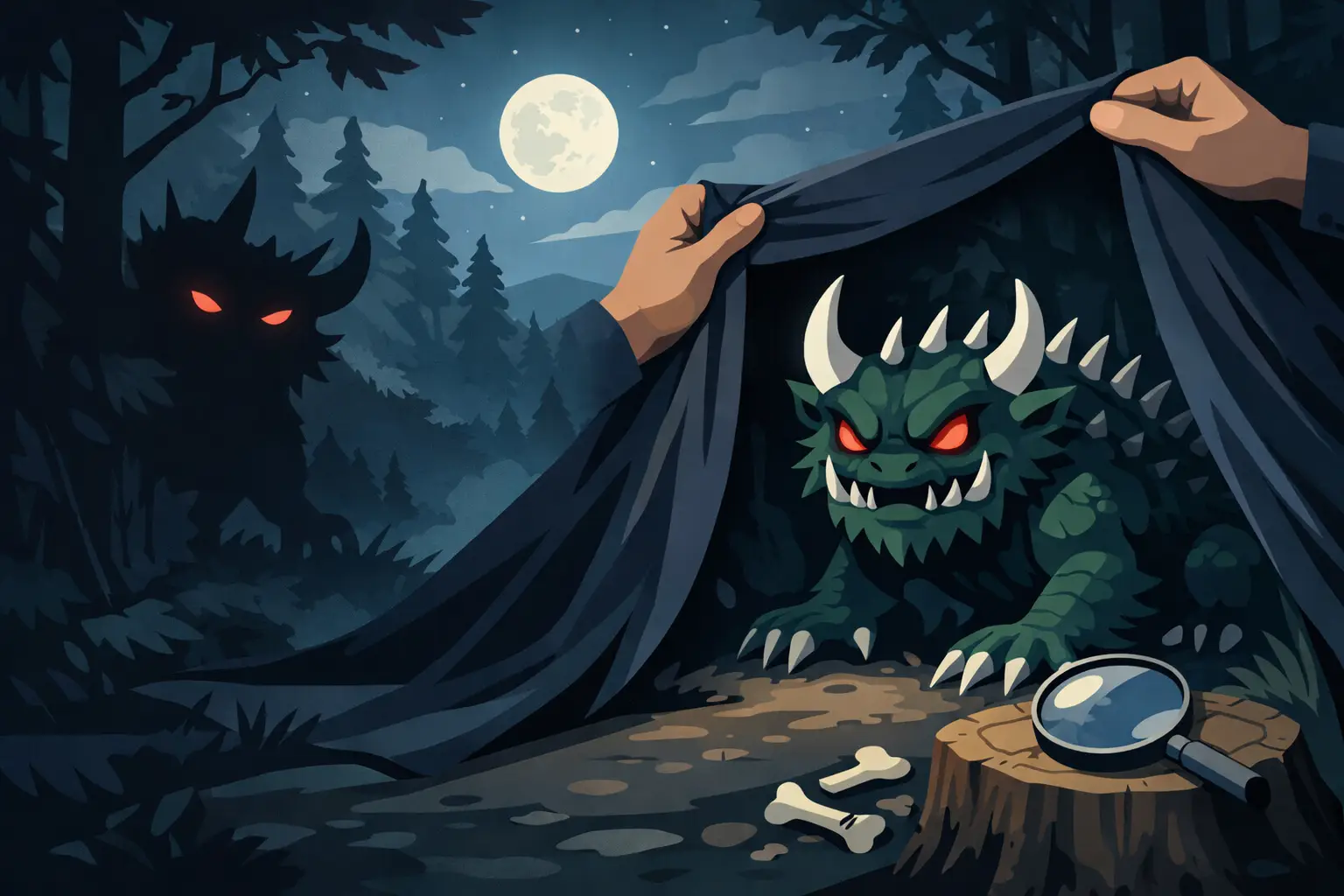
In the Hodag Wisconsin folklore story, a hideous black beast crawls out of northern timber country with horns, spikes, claws, and an appetite for trouble. It is part lumber-camp tall tale, part newspaper stunt, and part hometown mascot. Few American monsters have made the leap from a prankster’s imagination to the permanent identity of an entire city quite like the Hodag.
For collectors and folklore fans, that strange evolution is the point. The Hodag is not a creature preserved because someone proved it was real. It endured because Rhinelander, Wisconsin, kept choosing the monster as its own.
Where the Hodag Wisconsin Folklore Story Began
The Hodag first appeared in the 1890s, when northern Wisconsin was still defined by logging camps, rough work, and the kind of isolated nights that invite a good monster story. Its creator was Eugene Simeon Shepard, a Rhinelander land surveyor, newspaper man, and skilled promoter with a flair for the outrageous.
In 1893, Shepard published an account of a fearsome creature he called the Hodag. The original description was built for maximum campfire terror: a large, black animal with bull-like horns, a row of sharp spines down its back, glowing eyes, and a wicked grin. Some versions gave it the head of a frog and the face of an elephant. Others made room for tusks, claws, and a tail built to ruin anyone’s evening.
The name itself sounded ancient, wild, and local. That mattered. A monster does not need a neat scientific label to take hold. It needs a name people can shout across a bar, print in a headline, or whisper before a walk through dark trees.
Shepard’s first Hodag tale claimed that he and a group of men tracked and captured the beast, then destroyed it with dynamite. The story arrived with a photograph of what looked like a monstrous carcass. It was a classic tall-tale move: offer just enough detail to make the impossible feel briefly possible.
A Hoax With Real Teeth
Shepard was not merely telling a story. He built a physical Hodag from wood, animal hides, horns, and clever staging. The fake was photographed in low light and presented as evidence. Later accounts describe Shepard using a model and wires to create the impression of a living creature during another supposed expedition.
The most famous episode involved visitors said to include scientists from the Smithsonian Institution. Shepard claimed to have a live Hodag hidden in a pit or enclosed space, ready for inspection. Before the experts could get too close, local reporting exposed the trick. The beast may have been fabricated, but the spectacle was a success.
That distinction is worth holding onto. Calling the Hodag a hoax does not make it lesser folklore. The hoax is the folklore. Shepard created a monster in public, invited people to react to it, and gave Rhinelander a story powerful enough to outlive the reveal.
Why This Wisconsin Monster Stuck
Many fake creatures disappear when the joke is over. The Hodag did the opposite. It became more vivid after its false origin was known because it filled a cultural space larger than one man’s prank.
Northern Wisconsin had its own landscape, labor history, and sense of distance from the polished stories of big cities. Lumber camps produced a whole menagerie of exaggerated beasts, from fearsome critters designed to explain strange noises to tales told simply to entertain newcomers. The Hodag belonged naturally in that world. It was ugly, unruly, and perfectly suited to the deep woods.
It also had the advantage of being unmistakable. A generic beast can drift away from its birthplace. The Hodag’s silhouette does not. Horns, spines, snarling teeth, and that peculiar black-and-green color scheme make it instantly recognizable. It looks like a creature that could only have been dreamed up beside Wisconsin pines.
Rhinelander embraced it as a civic symbol. The Hodag appears in local businesses, public art, events, school spirit, and community identity. Rhinelander High School teams are the Hodags, a rare mascot name that turns every game into a small act of regional folklore. The city’s affection is not ironic in the dismissive sense. It is proud, playful, and earned.
That is how a legend survives in America. It becomes useful. It gives locals a shared reference point and gives visitors a story they cannot get anywhere else.
What the Hodag Reveals About Folklore
The Hodag complicates the usual question: “Is it real?” If the question means biological reality, the answer is clear. Shepard made it up. But folklore is not a failed branch of zoology. It is a record of what communities choose to repeat, reshape, celebrate, and carry forward.
The Hodag is real in the ways that matter to culture. It is real on signs and jerseys. Real in the memory of Rhinelander. Real in the laughter of someone telling a visitor to watch the woods after dark. A legend can start as a fabrication and still become an honest expression of place.
That makes the Hodag different from cryptid stories built around unresolved sightings. Creatures like Bigfoot or the Jersey Devil often invite believers to search for proof. The Hodag invites people to enjoy the performance. Its magic lies in the wink. Everyone knows the beast came from a tall tale, yet everyone is still welcome to believe, just a little, when the road disappears into the trees.
There is a trade-off in that public familiarity. A monster embraced as a mascot can lose some of its menace. Bright logos, festival imagery, and friendly souvenirs soften the original nightmare creature. But that shift is also proof of the Hodag’s unusual strength. It can be scary, funny, nostalgic, and proudly local without losing its identity.
The Hodag’s Many Faces
No single Hodag design owns the legend. Early depictions can look rough and animal-like, while later versions lean into a more polished monster character. Some make it reptilian. Some make it shaggy. Some give it bright green accents and a mischievous cartoon grin. That variation reflects the way folklore actually works: a creature changes hands, then changes shape.
For artists and figure collectors, this creates a delicious problem. Should a Hodag be recreated as Shepard’s unsettling lumber-camp fraud, with crude taxidermy energy and too many horns? Or should it become the bold, black-and-green icon Rhinelander recognizes today? Neither choice is wrong. One honors the monster’s eerie beginning; the other honors the community that kept it alive.
The best interpretations usually leave room for both. Give it a silhouette that feels dangerous in a moonlit pine stand, then let the expression hint that it knows exactly how much trouble it has caused for more than a century.
A Creature Built for a 50-State Collection
The Hodag earns its place among America’s legendary creatures because it carries a complete regional story. It has a named creator, a documented prank, a distinctive visual language, a specific Wisconsin home, and generations of local adoption. It is not folklore floating in a vacuum. It is rooted in Rhinelander’s soil, timber history, and sense of humor.
That is the kind of creature worth bringing home. A Hodag on a shelf is not just a cool-looking beast with too many spikes. It is a reminder that the strangest American legends are often made where history, mischief, and local pride collide. Fablins was built for creatures like that: monsters with a state behind them and a story still prowling the map.
So if you find yourself in northern Wisconsin at dusk, listen closely. The snapping branch may be a deer. The gleam beyond the pines may be a reflector. Or the Hodag may be waiting, delighted that after all these years, you are still looking.