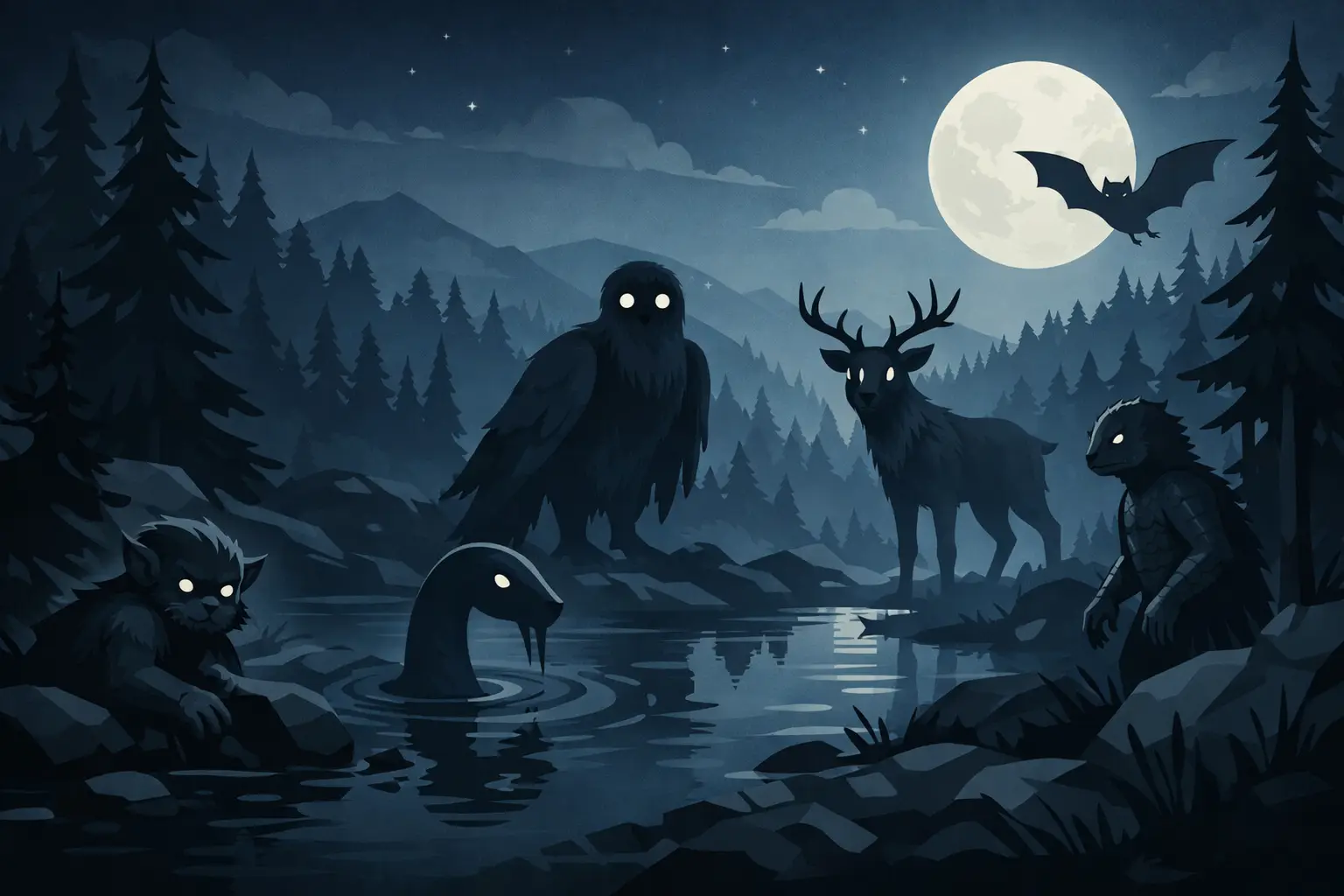
A glowing pair of eyes in an Arkansas treeline. A frog-faced visitor on an Ohio riverbank. A hairy giant pacing the woods outside a tiny Missouri town. Lesser known American cryptids thrive where the road gets quieter, the gas station stories get stranger, and a region refuses to let its favorite monster disappear.
Bigfoot and Mothman get the posters. These creatures belong to the rest of the map: local legends shaped by coal country, lake country, desert country, and the deep woods. Some began as newspaper reports. Others grew from campfire rumors, old folktales, or a town's wonderfully stubborn imagination. Their details change with every retelling. That is part of the magic.
Why Lesser Known American Cryptids Matter
A cryptid is usually described as a creature whose existence has been claimed but not proven by mainstream science. Folklore is bigger than that definition. It holds warnings, jokes, anxieties, local pride, and the feeling that a familiar place still has teeth after dark.
That distinction matters. Not every regional being should be flattened into a generic "monster," especially where a story belongs to a living Indigenous tradition. The best way to meet these legends is with curiosity and context. Learn where a tale comes from, notice who tells it, and let the creature remain stranger than a souvenir-shop slogan.
Here are 12 creatures that prove America has far more than a few famous shadows in its woods.
12 Lesser Known American Cryptids by Region
The Ozark Howler of Arkansas and Missouri
The Ozark Howler is a midnight riddle with several answers. Witnesses have described something bear-sized, black-furred, horned, and catlike, with glowing red eyes and a howl that travels too far through the hills. Other versions make it more canine. That inconsistency is not a flaw. The Ozarks are vast, wooded, and full of old stories, and the Howler feels built for a landscape that swallows the road behind you.
Momo, Missouri's Monster
Momo, short for the Missouri Monster, made headlines around Louisiana, Missouri, in 1972. Reports described a huge, hairy, foul-smelling creature with a pumpkin-shaped head and startlingly wide eyes. Momo arrived during an era when monster sightings could turn a quiet town into national news overnight. Yet its staying power comes from the details: not just a distant ape-man, but a swampy, local presence with a very Missouri kind of menace.
The Fouke Monster of Arkansas
Near Fouke, Arkansas, the creature is often described as a hulking, hair-covered humanoid with a terrible smell and a thunderous stride. The Fouke Monster became a regional sensation after reports in the 1970s, eventually inspiring a famously scrappy creature feature. It shares some traits with Bigfoot, but its identity is rooted in the Arkansas bottomlands. Put it in a Pacific Northwest forest and it loses the mud on its boots.
The Enfield Horror of Illinois
In 1973, residents of Enfield, Illinois, reported a bizarre creature said to have three legs, short arms, pink eyes, and a body that looked part animal, part nightmare. It allegedly leapt with astonishing force and made strange hissing sounds. The Enfield Horror has the fever-dream logic of a small-town flap: a few reports, plenty of attention, and an image too odd to forget. It remains one of the Midwest's most wonderfully offbeat monsters.
The Loveland Frog of Ohio
Ohio's Loveland Frog is less a single beast than a series of strange encounters. The best-known stories describe a roughly human-sized frog-like figure near the Little Miami River, sometimes standing upright and sometimes carrying what appeared to be a wand. A police officer's 1972 sighting helped cement the legend, though a later explanation suggested an escaped pet or large iguana. Maybe. But few practical explanations can outshine a frog wizard in the local imagination.
The Melon Heads of the Great Lakes
Michigan, Ohio, and Connecticut all have versions of the Melon Heads: small, big-headed figures said to live in the woods near abandoned institutions or lonely roads. The origins vary sharply by state, often mixing urban legend with cruel and sensationalized ideas about disability and institutionalization. That makes this one worth handling carefully. The enduring eerie image is real folklore, but the older claims should not be repeated as fact or used to mock vulnerable people.
The Lizard Man of Scape Ore Swamp
South Carolina's Lizard Man burst from the Scape Ore Swamp in the late 1980s after reports of a green, red-eyed, scaly creature near Bishopville. Witnesses described clawed hands, great strength, and an appetite for damaging cars. The story has a glorious creature-feature quality, but its setting does much of the work. A dark swamp is already an invitation to imagine something watching from just beyond the reeds.
The Lake Worth Monster of Texas
Texas has monsters large enough for its landscapes, but the Lake Worth Monster is especially memorable. Reports from the late 1960s described a shaggy, goatlike or ape-like creature prowling near Fort Worth's Lake Worth. It allegedly threw a tire at one witness's car, which is an oddly specific touch that makes the tale feel both ridiculous and indestructible. A monster that throws tires understands local legend better than most.
The Mogollon Monster of Arizona
The Mogollon Monster haunts Arizona's rugged Mogollon Rim in reports dating back well over a century. It is commonly described as a massive, hairy, humanlike creature with a powerful odor and chilling screams. Yes, it resembles Bigfoot at first glance. But the terrain changes the character: steep ravines, pine forests, and high desert weather give this legend a harder edge. The Mogollon Monster belongs to a place where the wilderness can change its mind fast.
The Bear Lake Monster of Utah and Idaho
Bear Lake, straddling Utah and Idaho, has its own long-necked water mystery. Nineteenth-century reports and later retellings describe a serpent-like creature with a horse-shaped head or sinuous body moving through the cold blue water. Lake monsters are often easy to dismiss from shore, until the water goes still and deep enough to hide a whole second world. Bear Lake gives that feeling a name.
The Shunka Warak'in of Montana
The Shunka Warak'in is one of America's stranger frontier-era animal tales, often linked to a taxidermied specimen once displayed in Montana. Descriptions vary, but it is generally portrayed as a wolfish, hyena-like animal with an unusual build and a bad temperament. Whether it was an unknown creature, an altered mount, or a misidentified animal, the story captures a real frontier impulse: when an animal does not fit neatly into the field guide, the legend begins.
Pukwudgies of Massachusetts
In parts of Massachusetts, especially around the Hockomock Swamp, Pukwudgies are often described in popular retellings as small, elusive woodland beings. But this is not simply a spooky forest-creature story to detach from its roots. Pukwudgies belong to Wampanoag tradition, a living cultural context that deserves respect rather than casual monster branding. Their presence is a reminder that folklore is not always public-domain decoration. Sometimes the right response is to listen, learn, and leave the story connected to its people.
A Map Full of Monsters, Not Copies
The most memorable cryptids are not interchangeable hairy things with glowing eyes. They carry the weather, waterways, industries, fears, and humor of the places that made them. A swamp creature should feel at home in swamp water. A mountain beast should sound like it knows every ravine. A town legend should preserve the odd little details locals refuse to surrender.
That is the thrill behind a state-by-state collection of America's legendary creatures. Fablins treats each figure as more than a monster on a shelf: it is a tiny ambassador from a specific patch of haunted American ground.
Next time you pass a brown lake, an empty roadside stand, or a treeline that seems a little too still, resist the urge to make every shadow into Bigfoot. Ask the better question: which creature already lives here?