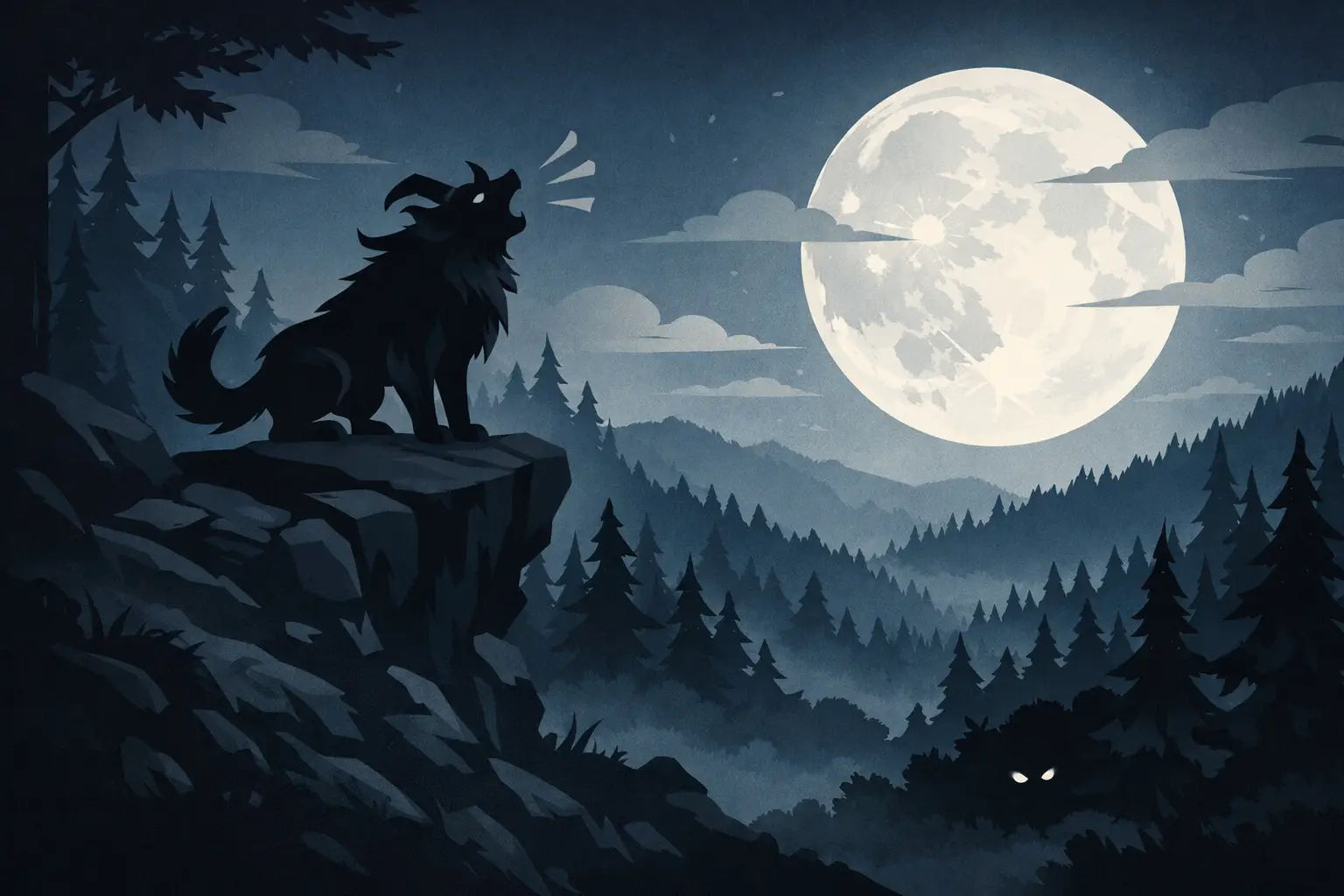
A scream rolls across an Ozark hollow after dark. It is too deep for a coyote, too ragged for a person, and too close to ignore. Somewhere beyond the tree line, people say, something with glowing eyes and a catlike body is answering the night. The Ozark Howler folklore origins are as tangled as the region’s back roads: part animal encounter, part immigrant memory, part campfire warning, and part modern cryptid imagination.
The Howler belongs to Missouri and Arkansas most of all, though its territory spills wherever the Ozark Plateau’s forests, bluffs, caves, and lonely gravel roads begin to feel endless. It is not a creature with one official description or a single ancient source. That uncertainty is not a flaw in the legend. It is the reason the Howler still has teeth.
A Cry Between Two Ridges
The Ozarks are built for stories that refuse to sit still. Dense woods swallow sound, limestone caves open beneath familiar ground, and ridges can make a distant animal seem as if it is calling from directly behind you. In that landscape, a strange noise does not stay just a strange noise for long.
Most versions of the Howler begin with its voice. Witnesses describe a terrible howl, roar, scream, or prolonged yelp that seems bigger than any ordinary animal. Some compare it to a wolf. Others hear a panther, a wounded woman, or several animals crying at once. The sound is often said to come in the dead of night, when a person has few useful ways to test what they heard and plenty of reasons to get back inside.
Then comes the shape in the dark. The Ozark Howler is frequently described as a massive, bear-sized cat or dog with horns, glowing red or yellow eyes, and a long tail. Sometimes it has a goatlike head. Sometimes it resembles a black panther with an attitude problem. In other tellings, it is simply a huge, shaggy thing moving low through the brush.
That shifting appearance tells us something crucial. The Howler was never meant to be pinned down like a museum specimen. It is a regional warning given claws.
Ozark Howler Folklore Origins: More Than One Source
Trying to name one clean origin for the Ozark Howler is tempting, but the legend is better understood as a creature assembled over time. It draws from real wildlife, older Old World supernatural traditions, and the storytelling habits of communities living close to the woods.
The mountain lion in the room
A major piece of the puzzle is the persistent idea of a big cat in the Ozarks. Mountain lions historically ranged through much of North America, including the broader region. Even after local populations declined or disappeared, sightings and rumors did not vanish. People continued to report panthers crossing roads, watching from hillsides, or screaming from the woods.
That last detail matters. Mountain lions can make startling vocalizations, including shrieks that sound almost human. Foxes, bobcats, coyotes, barred owls, and other nocturnal animals can also produce calls unfamiliar to anyone hearing them from a porch at 2 a.m. A real animal does not have to be identified correctly to become folklore. It only has to be heard at the right moment.
But the Howler is more than a misidentified cougar. The horns, glowing eyes, oversized body, and supernatural dread push it beyond the animal world. Wildlife likely supplied the tracks, cries, and quick shadows. Folklore supplied the monster.
The black dog that crossed the ocean
Another powerful influence may be the British and Irish tradition of the spectral black dog. Across England, Scotland, Wales, and Ireland, tales told of huge dark hounds haunting crossroads, churchyards, isolated lanes, and lonely stretches of country. Some were omens of death. Some guarded hidden places. Some simply appeared when a traveler was already uneasy enough to believe in them.
Settlers brought those story patterns with them to the United States, along with their accents, songs, religious beliefs, and family warnings. In the Ozarks, an old black-dog legend could easily merge with local tales of panthers, wolves, wild hogs, and unexplained cries. The result was not a copied European monster. It was something newly American: a beast shaped by the particular fears and landscapes of the hills.
The Howler’s occasional horns may also echo older devilish imagery. In rural storytelling, horns are an efficient signal. They tell the listener that this is not merely a dangerous animal. This is a creature that may know you are there.
From local warning to named cryptid
Many communities have stories about strange animals before anyone gives those stories a polished name. A grandmother may warn children away from a ravine because something screams there. Hunters may trade accounts of impossible tracks. Neighbors may disagree about whether they saw a panther, a bear, or nothing at all.
The modern Ozark Howler emerged as those scattered kinds of stories were gathered, repeated, and given a memorable identity. Cryptid books, paranormal radio, message boards, regional websites, and social media helped turn a broad family of Ozark monster tales into one recognizable creature. That process is not fake folklore. Folklore is not frozen in a jar. It adapts to the tools people use to tell it.
Still, there is a trade-off. The more a legend becomes standardized, the easier it is to lose its local oddness. A tidy creature profile can make the Howler easier to recognize, but the older magic lives in the contradictions: the witness who insists it had horns, the hunter who swears it was a cat, and the family that will only say they heard something that should not have been there.
What the Howler Looks Like Depends on Who Heard It
The Howler’s inconsistent description is often treated as evidence against it. For folklore fans, it is evidence of a living legend. A creature reported in dozens of different places over decades should not look like it came from the same character sheet every time.
In some accounts, the Howler is a black, pantherlike predator. In others, it has the broad chest and heavy build of a bear. Horns appear often enough to have become part of its popular identity, yet they are absent from plenty of retellings. Its eyes may glow red, yellow, or orange, which could reflect an animal’s eyeshine caught in headlights or a flashlight beam. Or it could reflect the storyteller’s need to make the darkness look back.
The howl remains the most dependable feature because sound is where the Ozarks do their best work. You may not see what moves beyond the trees, but you can hear it. Sound crosses hollows, bounces off stone, and grows stranger with every ridge between the source and the listener.
Why the Messy History Makes It Better
The Ozark Howler does not have the neat historical paper trail of a famous urban legend. There is no single first witness everyone agrees on, no ancient manuscript with a perfect horned-beast sketch, and no final answer waiting at the bottom of a cave. Claims that it is either an ancient Ozark monster or entirely invented last Tuesday both miss the point.
Its roots are layered. The Howler carries the possibility of real predators and unfamiliar animal calls. It carries immigrant ghost-dog traditions and rural Christian imagery. It carries the old, practical fear of being far from help after sunset. It also carries the modern delight of naming the thing in the woods and giving it a place among America’s legendary creatures.
That combination makes it especially suited to the Ozarks. This is a region where local identity is strong, stories travel through families, and the land has always been treated as something more than scenery. A road may be just a road in daylight. After a howl from the timber, it becomes a boundary.
The Howler’s Place in American Monster Country
The Ozark Howler stands apart from the country’s most overexposed cryptids because it feels regional down to its bones. It is not simply a generic monster dropped into Missouri or Arkansas. Its legend needs the wooded ridges, the animal calls, the inherited superstitions, and the uneasy silence between rural homes.
That makes the creature a natural fit for a collection built around place. Fablins celebrates the creatures that haunt American folklore state by state, and the Howler is a reminder that a monster can belong to a landscape as surely as a river, a cave, or a local accent.
So if you hear something howl across an Ozark valley, you do not have to decide whether it was a cougar, a fox, a distant dog, or a horned phantom with ember eyes. Folklore begins in that unanswered moment - when the woods make a sound, everyone goes quiet, and somebody says they have heard it before.