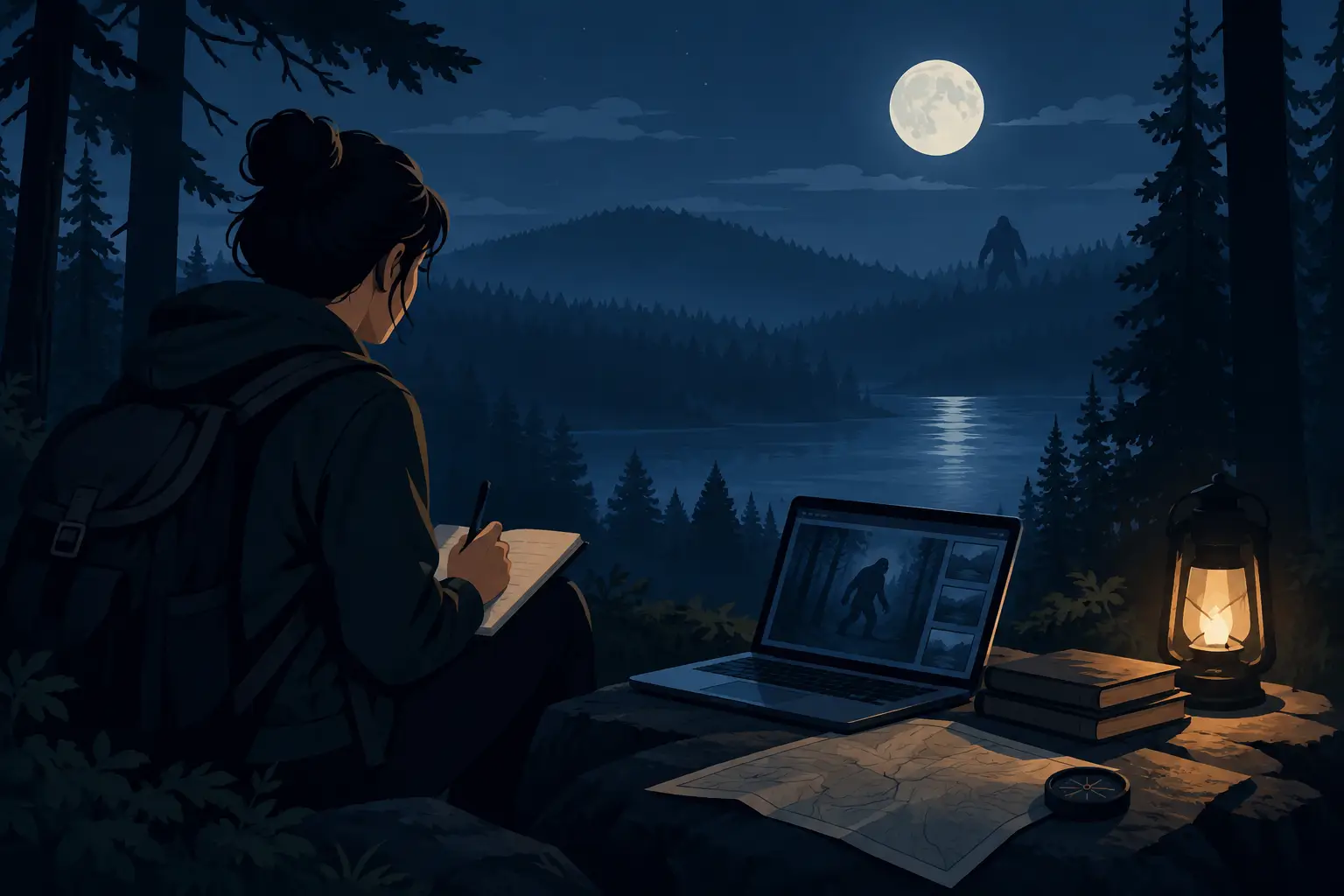
Every town has a story someone swears is true. A shape crossing a back road. A whistling heard beyond the tree line. A creature blamed for missing livestock, bad luck, or the feeling that you should not take the old bridge after dark.
To research local legends is to follow those stories back through the places, people, and fears that made them stick. The goal is not to flatten every mystery into a fact-check or declare every witness correct. It is to find the real folklore hiding beneath the retellings: who told the story, when they told it, what the landscape looked like, and why that particular monster belonged there.
America is full of legendary creatures, but the strange stuff gets better when it has an address.
Start With a Place, Not a Monster
A common mistake is beginning with a creature name and chasing every spooky result online. That route usually leads to recycled listicles, copied claims, and a photo of an owl labeled as something far more dramatic.
Start instead with a place you can picture. Pick a county, a mountain range, a river town, a neighborhood, a state park, or the stretch of highway everyone avoids at night. Local legends grow from physical details. A swamp creates one kind of fear. An abandoned mining camp creates another. A cold lake, a stormy coast, and a lonely stretch of prairie all give a tale its own teeth.
Ask simple questions before you look for answers. What industries shaped the area? Was it a logging town, a railroad stop, a military site, or farming country? Which communities lived there over time? Did the region experience a major disaster, displacement, violent conflict, or a long-running environmental concern? Folklore often remembers what official histories smooth over.
A story about a hairy thing in the woods may be about an animal. It may also be about dangerous terrain, outsiders, a lost local industry, or the uneasy boundary between settled land and wilderness. The creature matters, but so does the world that created it.
How to Research Local Legends Beyond Search Results
Online searches are useful for finding leads, especially alternate spellings and old names. They are not the finish line. If ten websites repeat the same sentence with no source, you have found a rumor traveling in a pack, not proof of a tradition.
Look for local materials that were created close to the story. Newspaper archives can reveal when a sighting first appeared, whether it was reported seriously or as a joke, and how the details changed over the years. Search by town name, county name, landmark, road, creek, and nicknames. A legend may never appear under the polished name it has today.
Public libraries and historical societies are treasure rooms for regional weirdness. Ask about local-history files, oral-history collections, community newsletters, school yearbooks, clipping binders, and books by local historians. The small, unglamorous materials are often where the good stuff lives. A librarian may know that a creature story was printed in a defunct weekly paper or passed around at a county fair for decades.
University archives can add another layer, particularly where folklore, anthropology, regional studies, or American history programs have collected field recordings and interviews. State archives may hold maps, court records, land surveys, photographs, and old government reports that explain the setting around a legend.
Do not ignore museums, volunteer fire departments, fishing clubs, old-timer groups, and community Facebook pages, either. These sources need more caution, but they can point you toward names, locations, and family stories that formal records missed.
Treat Oral Stories Like Living Things
The most valuable source may be a person who says, “My grandfather used to tell us about that.” That does not make the account lesser than a printed document. It makes it living folklore.
Listen before you correct, compare, or perform skepticism. Ask where they first heard the story, who told it, how old they were, and whether anyone in the community tells it differently. Ask what details people always include and which ones vary. Those variations are not necessarily errors. They can show how a legend adapts from family to family and generation to generation.
Take notes carefully. If you record someone, get clear permission first. Be honest about why you are gathering the story and how you might use it. Some tales are meant for public retelling. Others belong to a family, a neighborhood, or a cultural tradition with boundaries outsiders should respect.
This matters especially when researching Indigenous traditions, stories connected to racial violence, sacred places, or communities that have been treated as spooky scenery by outsiders. Not every story is yours to package, post, or turn into a monster hunt. Respect can be as simple as listening, citing the community’s own framing, and accepting that some knowledge is not available for public collection.
Separate the Legend From the Internet Costume
A local legend can be old without being ancient. It can be recently invented and still mean something. The question is not whether it has a medieval pedigree. The question is whether people in a place actually carry it, repeat it, and shape it into local identity.
Watch for warning signs when tracing a claim. A story may have been imported from another region and attached to a new location. A modern paranormal investigation may have supplied details absent from earlier versions. A promotional campaign, a prank, or a viral video may have created a creature almost overnight. None of that automatically makes the story worthless. It simply changes what you are researching.
Keep a basic timeline. Note the earliest version you can find, the source, the creature’s name, its reported behavior, and the location. Then track what changes. Did the creature gain glowing eyes after a movie came out? Did it move from one creek to an entire state? Did a ghost story become a cryptid because cryptids get more clicks? The transformations are part of the legend’s life.
It also helps to separate three categories in your notes: reported encounters, traditional stories, and interpretations. A reported encounter is what someone says happened. A traditional story is the version a community repeats. An interpretation is your best explanation for what the story may represent. Keeping them apart prevents a dramatic theory from disguising itself as a source.
Let the Landscape Do Some Talking
Maps are not just for locating sightings. They reveal the bones of a legend.
Compare old and current maps when you can. A road may have replaced a railroad line. A lake may cover a former settlement. A forest may have grown over land that was once heavily worked. A creature said to haunt an isolated place may have emerged from a location that used to be crowded, dangerous, or economically vital.
Names on the map are clues, too. Hollow, Devil’s Backbone, Dead Man’s Curve, Witch Creek, Booger Swamp: these names may preserve older anxieties, but they can also be later labels added for tourism or flair. Treat them as leads, not verdicts.
Season matters. A legend tied to winter, hunting season, flood season, or harvest may reflect practical risks. A tale about lights over marshland could involve natural phenomena, illicit activity, or a local warning to keep kids away from hazardous ground. Knowing the conditions does not drain the magic. It gives the magic a home.
Build a Legend File Worth Keeping
The best research files preserve uncertainty. Make room for contradictions instead of forcing every account into one clean origin story. A creature with five competing descriptions may be more folklorically interesting than one with a neat encyclopedia entry.
For each legend, keep the location specific, record dates when available, save exact quotations, and distinguish firsthand testimony from retellings. Include the source’s perspective. A hunter, a teenager, a park ranger, a local journalist, and a longtime resident may describe the same event in very different ways.
Add the details that make the creature belong to its region: its habits, sound, smell, territory, taboo, and the advice people give about avoiding it. Those details are the difference between a generic monster and one of America’s legendary creatures. They are why a figure on a shelf can carry the weight of a road trip, a hometown, or a story told around a campfire.
Fablins was built around that idea: 50 states, 50 legends. The creature is never just a creature. It is a piece of regional imagination with muddy boots, old maps, and a reason to haunt that particular corner of the country.
When you finish researching, resist the urge to pin the legend down too tightly. Leave some tracks unexplained. The best local stories survive because they give people something to argue about on the ride home - and something to listen for when the road goes dark.