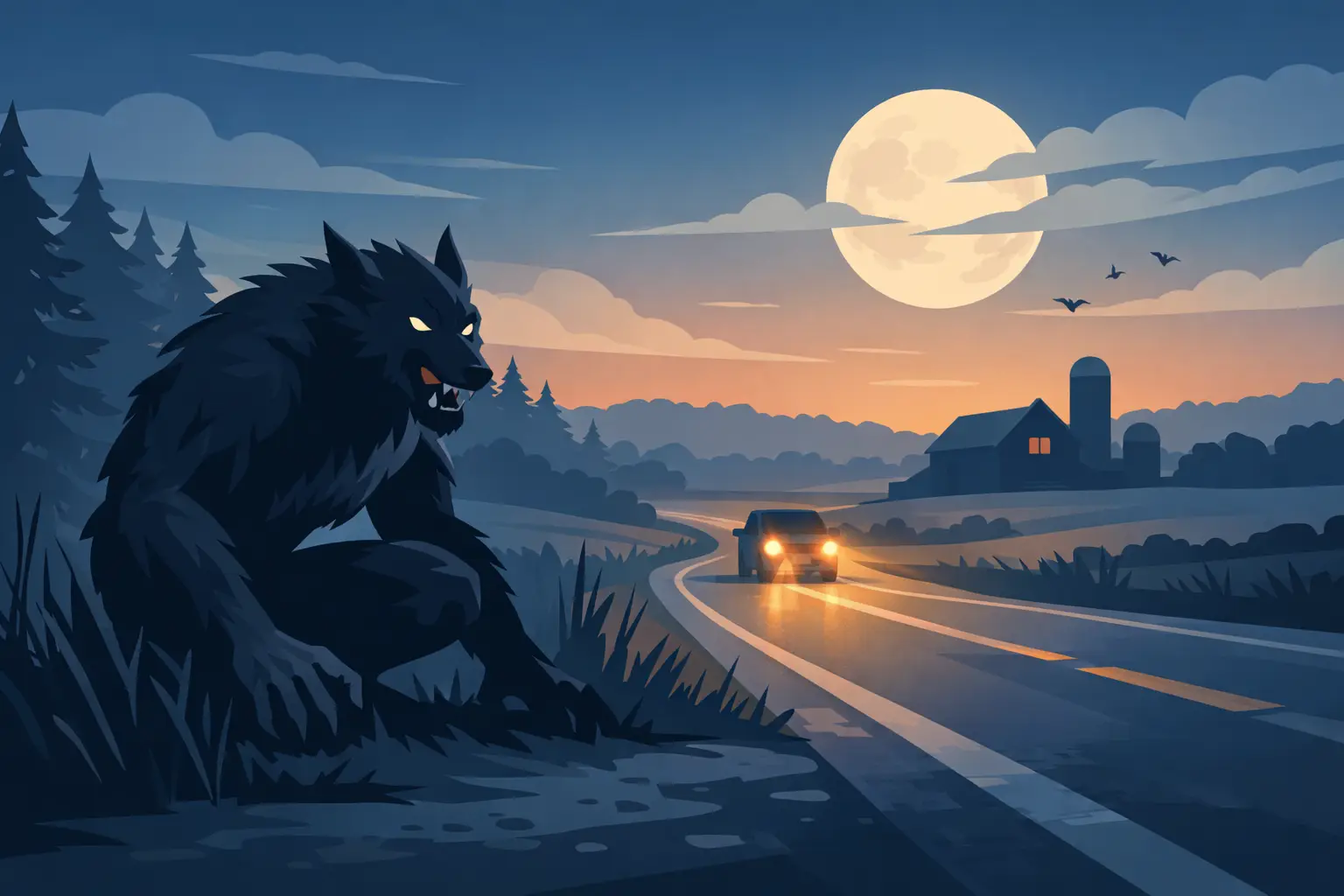
A dark road outside Elkhorn, Wisconsin, is not supposed to need a monster. Yet the Beast of Bray Road legend has turned one ordinary stretch of Walworth County into creature-country: a place where headlights catch movement in the ditch, where a hulking silhouette might stand too tall, and where local folklore refuses to stay in the past.
The beast is often called Wisconsin’s werewolf, but that label only tells part of the story. What makes Bray Road endure is not a single neat description of the creature. It is the uneasy collision of eyewitness reports, regional identity, newspaper-era panic, and the oldest rule of American folklore: once a place has a monster, every shadow there starts to look like it belongs to it.
What Is the Beast of Bray Road Legend?
The Beast of Bray Road is a reported wolf-like creature associated with rural roads near Elkhorn in southeastern Wisconsin. Witnesses have described something broad-chested and shaggy, with canine features, glowing or reflective eyes, and a habit of moving on two legs before dropping to all fours. Some accounts place it beside the road. Others put it near fields, woods, barns, or dead deer.
The most famous wave of reports came in the late 1980s and early 1990s, when stories from the area reached local journalist Linda Godfrey. Her reporting gathered accounts that might otherwise have remained private campfire material: drivers startled on lonely roads, people who believed something enormous had watched them from the tree line, and residents trying to make sense of a creature that did not fit comfortably into any known category.
That detail matters. The legend did not arrive fully formed, complete with one official monster profile. It grew through retellings. One witness sees a massive dog. Another sees a bear-like shape. Someone else remembers pointed ears, a muzzle, claws, or a humanlike stance. Folklore is rarely tidy. Its power comes from the details people cannot settle.
Not Every Witness Saw the Same Beast
The creature’s shifting appearance is often treated as proof that the story must be fiction. It can also be read as a clue to how legends work. People do not experience strange events as blank slates. They interpret them through what they know: horror movies, hunting stories, religious fears, local warnings, and the strange animal shapes the Midwest makes at night.
A large dog seen at the wrong angle can become a wolf. A bear can look almost human when it rears up. A deer carcass, road glare, fatigue, and a burst of adrenaline can build a terrifying memory in seconds. Those explanations are possible, and they are part of the legend’s texture.
But practical answers do not erase the story. They explain why a sighting may happen. They do not fully explain why one particular road, one particular county, and one particular beast captured imaginations so completely.
Why Bray Road Feels Like Monster Territory
Bray Road sits in a landscape made for uncertainty. Walworth County is not an untouched wilderness, which makes the legend even more compelling. It is a patchwork of farmland, woodlots, scattered homes, back roads, and pockets of darkness between familiar places. You can be minutes from town and still feel very far from help.
That in-between quality is where regional monsters thrive. The Beast of Bray Road is not a creature of distant mountains or a hidden swamp. It belongs to the edge of the ordinary: the roadside, the fence line, the place just beyond a vehicle’s headlights. It is the thing you might glimpse while driving home after work, leaving a friend’s house, or cutting through the countryside because the main road felt too slow.
Wisconsin also has deep roots in hunting culture, immigrant folklore, tavern tales, and winter-long nights. A wolf-like monster lands differently there than it would in a city apartment or a sun-baked desert town. Wolves carry real weight in the regional imagination. So do big dogs, coyotes, bears, and the fear of something wild crossing into human space.
The beast turns that tension into a character. It is not simply an animal. It is a local warning with fur on it.
A Werewolf, a Cryptid, or a Folklore Mirror?
Calling the creature a werewolf is memorable, but it can flatten the legend. Traditional werewolves are usually humans transformed by curse, bite, ritual, or moonlight. The Beast of Bray Road is more often described as an unknown animal or a creature that naturally shifts between wolfish and humanlike traits.
That puts it closer to the cryptid category: a creature reported by witnesses but not recognized by mainstream zoology. Still, cryptid is a modern label, and Bray Road does not need a perfect filing cabinet. The legend borrows from werewolf stories, dogman reports, frontier monster lore, and the universal fear of meeting something that looks almost familiar but not quite right.
That almost is the hook. A normal wolf has rules. A normal bear has rules. The Beast of Bray Road seems to stand outside them. It is said to carry itself with unsettling intelligence, to appear where it should not be, and to leave witnesses with the feeling that they were not merely seeing an animal. They were being noticed.
Whether anyone accepts that interpretation depends on what they want from folklore. Some people chase evidence. Others chase atmosphere. Both responses have a place, as long as the legend is treated with curiosity rather than cheap certainty.
The Newspaper Monster That Would Not Leave
Many local legends stay local because nobody writes them down. Bray Road had an advantage: its stories found a reporter willing to listen without sanding away every eerie edge. The resulting coverage gave scattered encounters a shared name, a shared location, and a shared creature.
Once that happens, a legend gains momentum. A witness who might have said, “I saw something strange,” can say, “I think I saw the Beast of Bray Road.” A road that was simply dark becomes charged. Visitors arrive looking for signs. Skeptics look for mundane explanations. Fans trade stories, make art, watch films, and add the beast to the growing map of American cryptids.
That does not mean every new account is evidence of a literal monster. Fame can shape perception. People know what they are looking for, and expectation is a powerful flashlight. Yet folklore does not become less meaningful because people participate in it. Participation is how it stays alive.
The Beast of Bray Road legend became bigger than any one sighting because Wisconsin claimed it. The creature now belongs to road trips, Halloween conversations, cryptid conventions, local pride, and the particular pleasure of knowing your state has something strange in the woods.
What the Beast Says About Wisconsin
Every state has landscapes that invite stories. Wisconsin’s legendary creatures often emerge from its forests, lakes, farms, and long rural miles. The Beast of Bray Road gives that geography a face, or at least a muzzle.
It also pushes back against the idea that folklore only lives in old books. This is a modern American monster, shaped by cars, local journalism, pop culture, and people telling friends what happened on a road after dark. The details may evolve, but the impulse is ancient. A strange encounter needs a name. A dangerous-feeling place needs a guardian. A community needs stories that belong to it and nowhere else.
For collectors and creature fans, that makes the beast more than a generic werewolf. It is a Wisconsin legend with mud on its paws. Its identity is tied to a real region, a real road, and a particular kind of midnight unease.
Fablins is built around that idea: America’s legendary creatures become even more interesting when you know where they haunt. A shelf full of monsters should feel like a map, each figure carrying a piece of local weather, warning, and wonder.
Keep Your Eyes on the Road
There is no final report that closes the Bray Road case. No specimen, no universally accepted photograph, no single explanation that satisfies everyone. That unresolved quality is exactly why the beast survives. It lives in the gap between what a witness saw and what everyone else thinks they saw.
If you ever travel through Walworth County at night, the sensible advice remains wonderfully boring: drive carefully, respect private property, and do not turn rural roads into a monster-hunting playground. But leave a little room for the strange. Somewhere beyond the beams of your headlights, Wisconsin’s most famous wolf-like shadow is still waiting for a name.