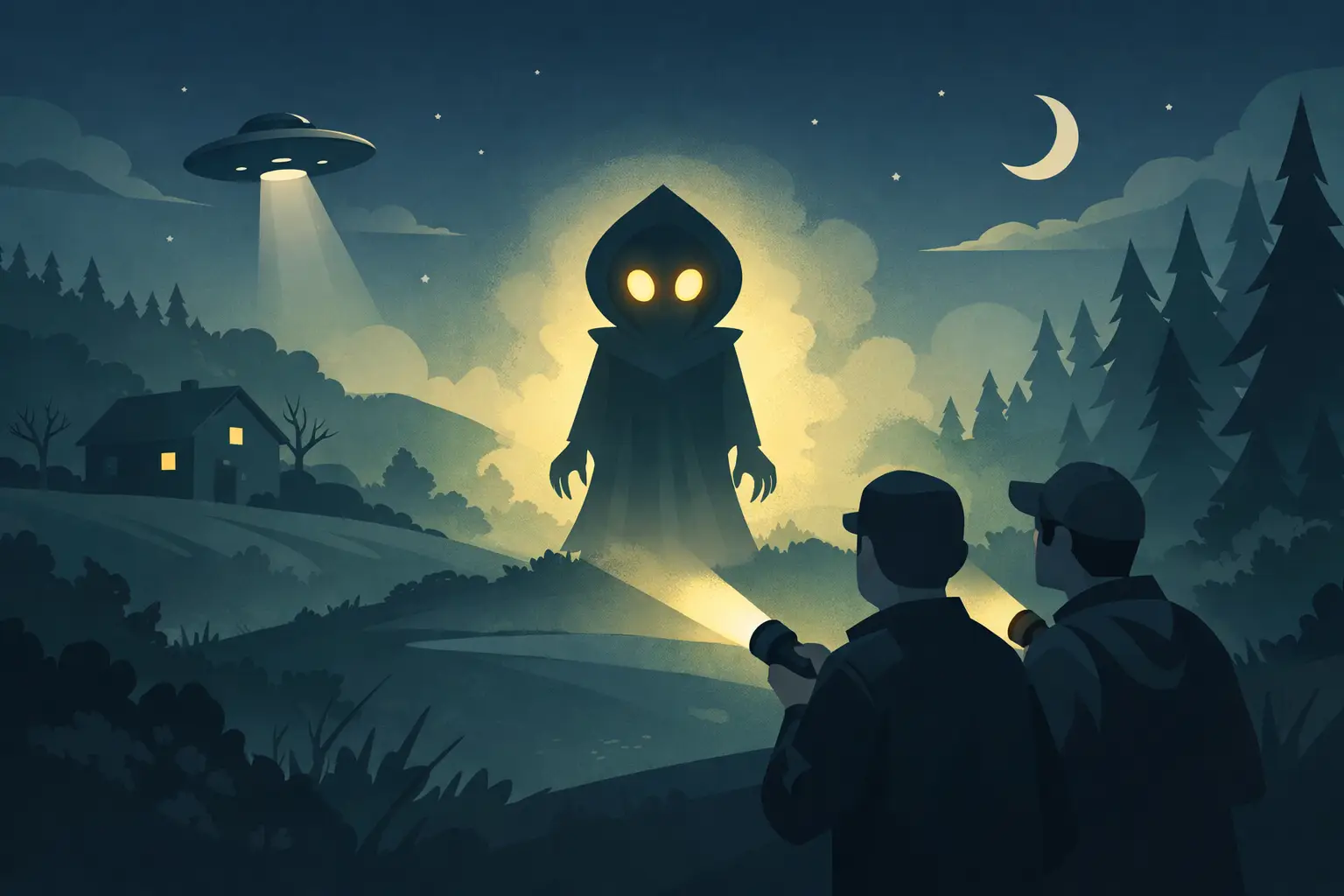
On September 12, 1952, a quiet West Virginia evening turned strange enough to outlive everyone’s certainty. The Flatwoods Monster encounter story starts with a bright object crossing the sky, but it ends in a dark hilltop encounter that still feels like it stepped out of a painted creature feature.
Flatwoods was a small Braxton County community, the sort of place where neighbors noticed a fire in the distance and kids could reach the woods before an adult had time to object. That night, a handful of witnesses followed a blazing sight toward a farm owned by the Fisher family. What they reported seeing there became one of America’s most enduring cryptid legends.
A Fireball Over Flatwoods
At roughly 7:15 p.m., local boys saw a red-orange object streak over the area and appear to land on a hill. The object was likely visible across a broad part of the region. Reports of a meteor or other flaming object came in from multiple states, which gives the first chapter of the story a possible earthly explanation.
But a meteor is only the opening scene.
Eddie May and his friends ran to tell his mother, Kathleen May, what they had seen. She gathered a small group to investigate. Along with several boys came National Guardsman Eugene "Gene" Lemon and his dog. They headed uphill through the dark, expecting perhaps a crashed aircraft, a fallen meteor, or a fire that needed reporting.
Instead, the group entered a patch of woods filled with haze and an odor described as sharp, metallic, or like sulfur. Lemon’s dog reacted badly, then later became ill. The witnesses also said they saw two lights near the hilltop. One may have belonged to a large object. The other, they believed, was watching them.
What the Witnesses Said They Saw
The central figure of the Flatwoods Monster encounter story is not a hairy woodland beast or a giant reptile. It is something stranger: tall, shadowy, and theatrical enough to become instantly recognizable in American folklore.
Kathleen May and the others described a creature around seven to ten feet tall. Its body appeared dark, perhaps greenish or black under the available light. It had glowing or shining eyes and a wide, hood-like shape around its head, often compared to an ace of spades or a pointed cowl. Some witnesses recalled long arms with claw-like hands. Others emphasized how little they could make out beyond the eyes, the outline, and the impression that it was not built like a person.
That last detail matters. Eyewitness accounts, especially in frightening conditions, are rarely identical. The group was moving through woods at night after chasing a fiery object. They were looking through mist, dealing with fear, and trying to understand unfamiliar shapes with only flashlights and whatever moonlight broke through the trees. Their testimony shares a vivid core, but the creature’s details changed as the story traveled through newspapers, radio, drawings, documentaries, and decades of retelling.
The classic Flatwoods Monster image - a looming dark body beneath a huge spade-shaped head - is partly witness memory and partly folklore’s own visual evolution. That does not make it less fascinating. It shows how a regional fright becomes a legend with a face.
The Mist, the Smell, and the Panic
The group did not stay to get answers. They ran.
Accounts describe a mist that irritated eyes and throats, plus a foul smell that clung to the scene. Several witnesses later reported nausea or sickness. Whether those symptoms came from fright, exhaust fumes, local vegetation, contaminated air, or something unknown remains part of the mystery. The local terrain had practical hazards, and human bodies under stress can turn a frightening event into a physical ordeal fast.
Still, the details stuck because they were so sensory. A glowing shape in the woods is scary. A glowing shape in the woods surrounded by choking mist and a harsh odor is the kind of thing a town remembers for generations.
Was It a Creature, a Machine, or a Misread Shape?
The Flatwoods case is strongest when treated as a real event with unresolved pieces, not as a puzzle that demands one tidy answer. Something crossed the sky. A group climbed the hill. They saw something alarming. They came back shaken. Beyond that, the explanations compete.
One popular skeptical theory identifies the creature as a barn owl perched in a tree. An owl’s reflective eyes, pale face, spread wings, and sudden movements can look deeply unnatural in a flashlight beam. Add a large leaf or branch structure behind it, and the famous hooded silhouette begins to seem possible. Critics of this explanation point out that it does not neatly account for every detail, especially the reported size, mist, odor, and connection to the object in the sky.
Another theory combines a meteor with ordinary objects on the hill: an owl, a fence, a tree, or military equipment. This is the most grounded answer, and it has a lot going for it. People often connect unrelated events when they happen within minutes of each other, particularly when fear is involved.
Then there is the extraterrestrial interpretation. In the early 1950s, flying-saucer reports had become part of American life, and the Flatwoods sighting arrived during a wave of public fascination with visitors from beyond Earth. To believers, the fireball, unusual vapor, strange odor, and nonhuman figure form one continuous encounter. To skeptics, that same sequence shows how quickly a scary night can acquire a science-fiction frame.
It depends on what kind of evidence you value. The case has multiple witnesses and a firm date, which gives it more weight than a campfire rumor with no names attached. It also has darkness, confusion, and evolving testimony, which make absolute certainty impossible.
Why This West Virginia Legend Endures
Many cryptid stories survive because their creatures are easy to describe: a giant bird, a lake monster, a hairy man in the trees. The Flatwoods Monster survives because it refuses to be ordinary. It looks less like an animal and more like an emblem from a forgotten space age - part alien, part ghost, part roadside nightmare.
Its timing helped, too. The story landed in postwar America, when rockets, atomic anxiety, television, pulp magazines, and UFO headlines were changing the country’s imagination. A creature on a West Virginia hill could feel both ancient and futuristic. It belonged to local woods, yet seemed to arrive from somewhere far beyond them.
For West Virginia, the legend is also a point of regional identity. Flatwoods did not lose its strange visitor to a national UFO file. The town kept it. Murals, events, local storytelling, and monster art have turned one terrifying night into a durable piece of Appalachian folklore.
That local ownership is the heart of great American monster stories. The creature is not just "the Flatwoods Monster." It is tied to a road, a hill, a community, and a particular September night. Geography gives a legend its claws.
The Monster We Remember Is Part of the Evidence
There is a temptation to ask whether the witnesses were right or wrong, as if those are the only two choices. Folklore asks a better question: what did this encounter mean to the people who carried it forward?
The answer is a creature that stands at the crossroads of fear and imagination. Even if an owl, meteor, or mistaken silhouette explains parts of the event, those explanations do not erase the human truth of it. A group of neighbors went looking for a light in the sky and came down the hill believing they had faced something impossible.
That is why the Flatwoods Monster belongs among America’s legendary creatures. It is not a clean case file. It is a living regional story, shaped by witness testimony, uncertainty, and a silhouette too strange to forget.
If you ever pass through central West Virginia after dark, look up when something bright crosses the sky. Then listen to the woods before you decide what followed it home. Fablins knows every state has a legend - and some of them are still standing at the edge of the flashlight beam.