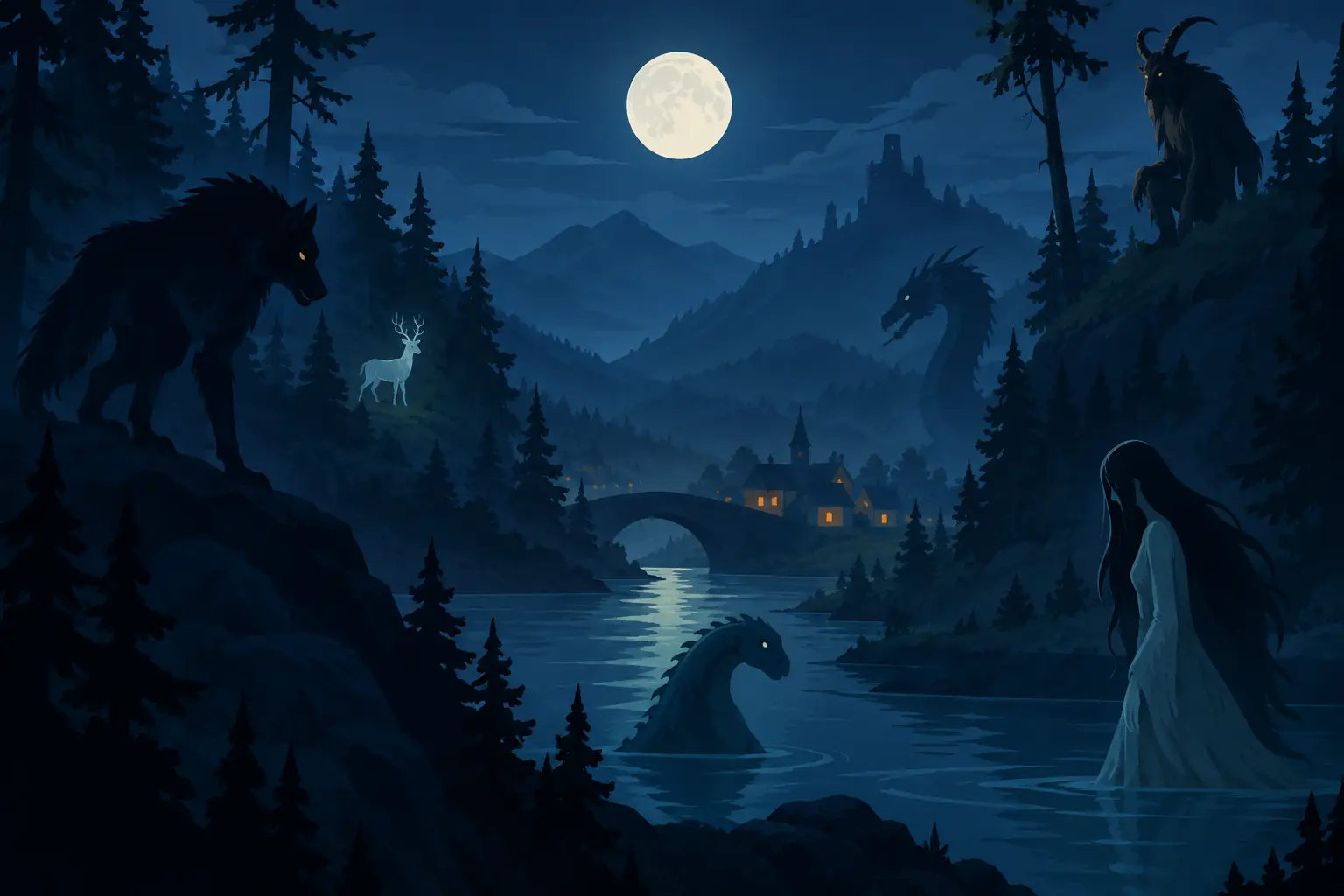
A monster is rarely born in a vacuum. Put the same fear in a Maine fishing town, a desert highway stop in Nevada, and a Mississippi river community, and it will grow different teeth. That is why folklore creatures vary regionally: legends absorb the land, the people, the work, and the dangers of the places that keep telling them.
America's legendary creatures are not interchangeable spooky mascots. They belong somewhere. A story about something in the woods means one thing beneath Appalachian ridges and another among Pacific Northwest evergreens. The creature may change its name, shape, habits, and warning, but its purpose remains wonderfully familiar: it gives a community a way to talk about what feels strange, threatening, or just beyond the firelight.
Why Folklore Creatures Vary Regionally
Regional folklore is local memory wearing claws. It gathers details from everyday life: a dangerous crossing, an unexplained sound, a brutal winter, a mine collapse, a predator in the brush, or a road nobody wants to take after dark.
Before national media flattened local mysteries into a handful of famous monsters, stories traveled at the speed of conversation. They moved through families, workplaces, schools, taverns, campsites, and front porches. Each retelling gave a creature a new detail that made sense to the people listening. A beast seen near a swamp needed to know the water. A mountain thing needed to understand cliffs, caves, and narrow hollows.
That is not a flaw in folklore. It is the whole magic trick. There is no single official version because a legend survives by belonging to the people who carry it.
The Land Gives the Creature Its Shape
Start with geography. The United States contains deep woods, wind-beaten coasts, dry basins, frozen lakes, tangled bayous, farmland, badlands, and mountain ranges old enough to feel watchful. A regional creature often behaves like an exaggerated answer to its environment.
In dense forest country, a legend may involve distant knocks, impossible footprints, glowing eyes, or something huge moving where visibility ends after twenty feet. In open country, the anxiety changes. You can see for miles, but there is nowhere to hide and little help if your car dies. A creature on an empty road can feel more immediate than one behind a wall of trees.
Water produces its own family of fears. Rivers hide currents, debris, depth, and things that vanish beneath the surface. Coastal stories pick up fog, shipwrecks, tides, and the unnerving fact that the horizon never tells you what is coming. Swamp creatures are not simply forest creatures with mud on them. The landscape changes the rules of movement, sound, escape, and visibility.
Weather matters too. Blizzards, heat waves, tornadoes, and heavy fog have all helped create the conditions where ordinary places become uncanny. When a landscape can genuinely hurt you, folklore does not need much encouragement to give it a face.
Animals Leave Their Tracks in the Tale
Many creatures borrow from real wildlife. A strange call becomes a warning cry. A half-seen animal becomes something larger in memory. Bears stand on two legs. Deer catch headlights at the wrong angle. Coyotes sound less like one animal than a whole pack of bad news.
That does not mean every legend is a mistaken animal sighting. It means local people build stories from the raw material around them. The animals already present in a region influence what kind of monster feels believable there. In a place where alligators are real, a story can stretch in a different direction than it can in a place where moose, wolves, or rattlesnakes own the imagination.
History Teaches Monsters What to Haunt
Folklore also keeps the fingerprints of history. Regions shaped by logging, mining, railroads, shipping, ranching, or factory work tend to produce stories connected to those worlds. A creature can become a warning against carelessness, greed, isolation, or wandering where you do not belong.
Consider the difference between a mining-town tale and a fishing-community tale. One may fear what waits underground, where darkness is total and the earth can shift without warning. The other may fear what rises from water, where storms and currents turn skill into luck. Both stories are entertaining. Both can also hold a serious memory of risk.
Migration and cultural exchange make the map even stranger. Indigenous traditions, African American folklore, immigrant stories, religious beliefs, military communities, and generations of local invention have all shaped American monster lore. Sometimes stories blend. Sometimes they sit side by side. Sometimes a newer legend borrows an old fear and gives it a fresh name.
Respect matters here. Folklore is not an empty costume rack for a generic horror aesthetic. Some stories are sacred, some are tied to real trauma, and some belong to living communities with their own ways of telling them. The best way to enjoy a regional creature is to stay curious about where it comes from, who has kept its story alive, and what it means in that place.
A Creature Is Often a Local Warning Sign
The monsters that haunt American folklore frequently do useful work. They tell children not to go near deep water. They tell travelers to respect the road. They explain why someone should not cut through the woods alone, ignore a storm, or trespass on land with a troubled history.
A legend can also give shape to feelings that are hard to name. Isolation, grief, economic uncertainty, distrust of outsiders, and fear of rapid change can all appear in creature stories. The monster is not always the point. Sometimes it is the mask a town uses to talk about what has been haunting it for years.
This is why two regions can share a broad creature type but tell radically different stories. A wild person of the woods, a lake monster, a phantom animal, or a night visitor may appear in many places. Yet the local version will carry different rules. Does it attack, warn, steal, mimic, protect, or simply watch? Can you hear it before you see it? Is it tied to a particular bridge, ridge, road, cave, or season? Those details turn a category into a legend.
The Story Changes Because People Keep Telling It
Folklore is alive, which means it is allowed to mutate. A tale told beside a campfire becomes a newspaper oddity. A newspaper oddity becomes a radio call-in. A radio call-in becomes a video, a meme, a podcast episode, or a story told by someone who swears their uncle saw it in 1987.
Every format changes what gets emphasized. A campfire tale wants atmosphere. A tabloid wants shock. An online post wants a memorable hook. A collector may want the creature's silhouette, its strange nickname, and the single detail that makes it instantly recognizable on a shelf.
There is a trade-off. Wider attention can preserve a regional legend that might otherwise fade. It can also sand off the odd, specific details that made the creature local in the first place. The famous version of a monster is often only one version, and usually not the most interesting one.
Fifty States, More Than Fifty Strange Corners
A state line cannot contain every story. Folklore often belongs to a county, a watershed, a mountain pass, a neighborhood, or a stretch of highway with no sign except the one locals ignore after sunset. Still, the state-by-state view reveals something remarkable: America is crowded with distinct supernatural ecosystems.
That is the thrill behind collecting regional legends. Each creature is a small piece of place. It can remind you of home, a road trip, a family story, or the unsettling realization that somewhere else in the country, people grew up checking a different patch of darkness.
Fablins celebrates that weird geography with one creature for every state, but the map is only the beginning. Ask a local about the monster nearest them. Listen for the name they use, the place they refuse to visit, and the detail no national retelling ever includes. That is where the legend is still alive.