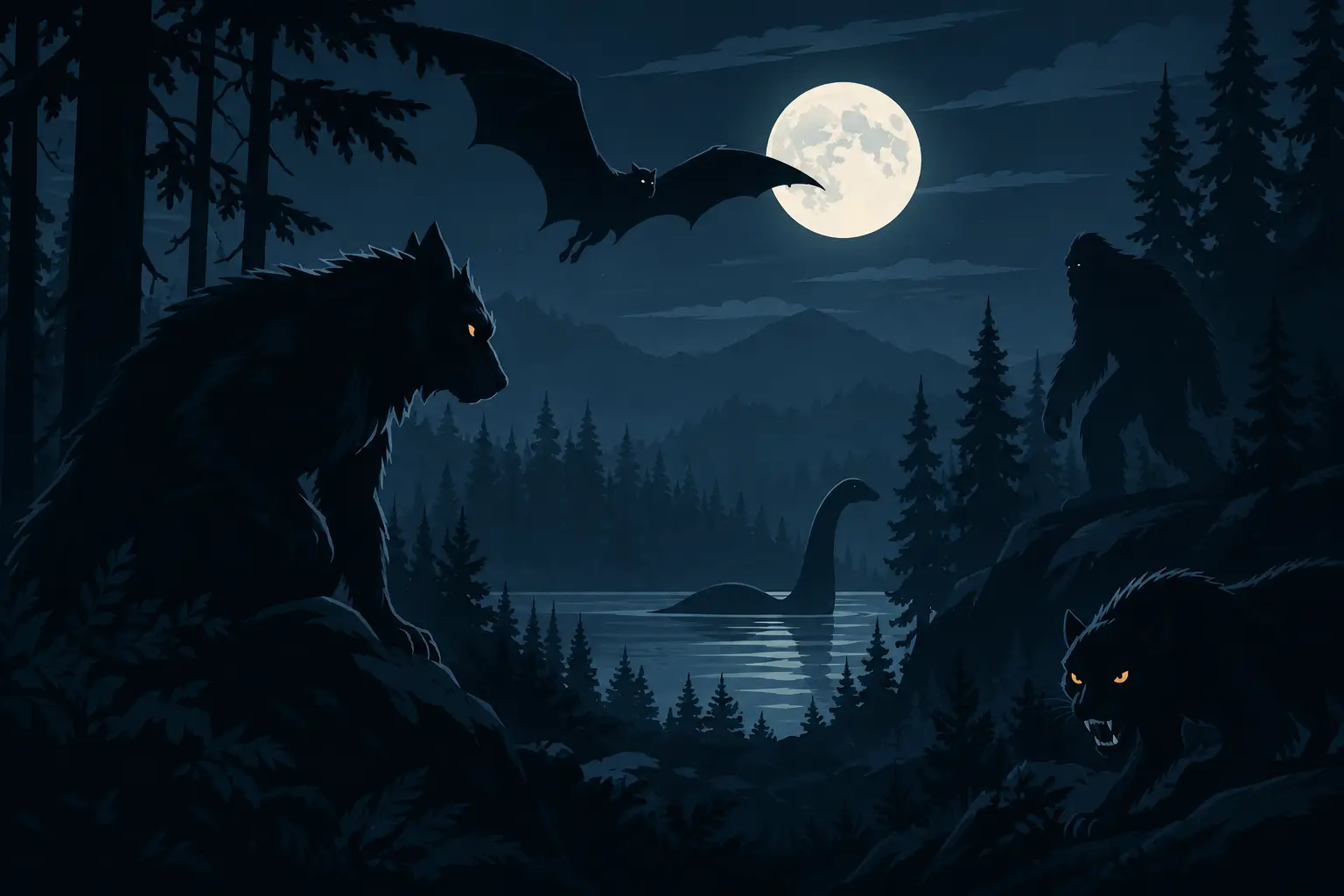
A newcomer to a northern logging camp might be warned not to wander after dark. Something with a long, hooked body and an appetite for lone travelers was said to wait behind the trees. It was called the Hidebehind, and it had one reliable weakness: it could not stand the sight of a man who had been drinking.
That detail tells you nearly everything about the history of fearsome critters. These were not merely monsters built to frighten people. They were campfire creatures, practical jokes with claws, and tall-tale animals shaped by a hard life in the American woods. They stalked lumber camps, railroad camps, mining towns, and frontier settlements, where a good yarn could make a long night shorter.
What Were Fearsome Critters?
Fearsome critters were imaginary North American animals, especially popular in the late 1800s and early 1900s. Their names alone sound like something overheard through pine branches: the Hugag, the Whintosser, the Goofus Bird, the Leprocaun, the Agropelter, and the Sidehill Gouger.
Most were described with the straight-faced confidence of a field guide. A critter might have mismatched legs for walking mountain slopes, elastic jaws for swallowing impossible meals, or an odd hatred for a particular kind of human. The descriptions often included a range, diet, habits, and an absurd method of capture. That mock-seriousness was the point.
The creatures belonged to a specific kind of American folklore. They were usually invented, embroidered, and shared by workers rather than handed down as sacred traditions. One storyteller could add a new feature. The next could make it worse. Before long, a beast born as a prank had a territory, a hunting pattern, and enough witnesses to fill a bunkhouse.
The Lumberwoods Made a Monster Factory
The strongest roots of fearsome critter lore run through the lumber camps of the Upper Midwest and Northeast. Logging was dangerous, exhausting work. Camps brought together people from different regions, countries, and languages, then dropped them into isolated forests for months at a time. Stories became entertainment, social glue, and a way to test the greenhorn.
A veteran logger could describe a beast with absolute authority while a newcomer listened for snapping branches outside. Sometimes the joke was gentle. Sometimes it was a rite of passage. The newcomer might be sent to find a “board stretcher,” hunt a rare animal, or keep watch for a beast that did not exist.
These stories also turned real dangers into characters. Falling limbs, deep snow, disorientation, bears, and the unnerving silence of the woods all had a place in camp life. A creature like the Agropelter, said to hurl branches at intruders, made comic sense to anyone who had worked beneath a canopy of deadwood. The monster gave workers a name for the forest’s hostility, then gave them a reason to laugh at it.
Fearsome critters were never confined to one map. Lumber folklore traveled with workers, newspapers, postcards, hunting stories, and cheap printed booklets. Creatures migrated from Maine to Michigan, from Wisconsin to the Pacific Northwest. Their details changed along the way, as good monsters always do.
When Tall Tales Became Field Guides
The history of fearsome critters took a major turn when authors began collecting them in print. In 1910, Minnesota state forester William T. Cox published Fearsome Creatures of the Lumberwoods, With a Few Desert and Mountain Beasts. Presented with scientific-looking illustrations and deadpan descriptions, the book preserved a parade of strange animals for readers far beyond logging country.
Cox did not invent the whole bestiary. He gathered stories already moving through camps and communities, though printing them gave the creatures a more official afterlife. Once a monster appeared beside a formal Latin-like name and a tidy drawing, it became much easier to imagine it lurking just over the next ridge.
Later collections helped widen the tradition. Henry H. Tryon’s 1939 Fearsome Critters cataloged more of these impossible animals and treated the lore as a distinctive piece of American cultural history. By then, the critters had become recognizable folk characters: less local rumor, more national oddity.
That shift matters. Oral folklore changes fast and often disappears with the people who tell it. Printed folklore can survive, but it can also freeze a story in one version. The famous drawings of fearsome critters are part of their magic, yet no illustration can capture every campfire variation. The real creature was always the story being told in the moment.
The Hodag and the power of a good hoax
The Hodag of Rhinelander, Wisconsin, sits slightly apart from many fearsome critters because it was tied to an elaborate local hoax. In the 1890s, Eugene Simeon Shepard claimed to have discovered and captured the beast, a horned, reptilian terror said to haunt the woods. Photographs and public displays helped sell the tale.
The Hodag eventually outgrew the trick. It became a beloved emblem of Rhinelander, proof that a made-up monster can become part of a town’s real identity. That is folklore’s favorite transformation: someone tells a lie for fun, the community keeps the best part, and generations later the creature belongs to everyone.
Not Every American Monster Is a Fearsome Critter
It is tempting to use “fearsome critter” as a catchall for every strange beast in American folklore. That flattens the map.
Fearsome critters are closely associated with occupational tall tales, especially those of lumber camps and frontier labor. Other creatures have different roots. Indigenous nations across North America hold living traditions with their own languages, responsibilities, and meanings. Regional ghost stories, African American folk traditions, immigrant legends, lake monsters, and modern cryptids also emerge from distinct communities and histories.
A respectful monster map keeps those differences visible. The point is not to throw every unusual creature into one spooky bucket. The point is to notice who told the story, where it traveled, what it meant to its community, and whether it was meant as warning, belief, entertainment, or all three at once.
That distinction also separates fearsome critters from cryptids. A cryptid is generally treated as an animal some people believe may exist, whether or not evidence supports the claim. Fearsome critters were often knowingly ridiculous from the start. But the border is porous. A story can begin as a joke, become a local legend, and eventually inspire sincere speculation. America has always enjoyed leaving a little room for the impossible.
Why These Creatures Still Matter
Fearsome critters endure because they are intensely regional without being sealed off from the rest of the country. A Sidehill Gouger belongs to steep terrain. A Squonk belongs to Pennsylvania’s forests and its old industrial imagination. The Goofus Bird, which flies backward because it does not care where it has been, belongs anywhere somebody appreciates a creature with terrible judgment.
They also feel surprisingly modern. Their anatomy is cartoonish, their names are memorable, and their personalities are bigger than life. They were character design before character design had an aisle at a convention. Each one arrives with a silhouette, a habitat, a problem, and a story collectors can repeat.
For folklore fans, that makes fearsome critters more than quaint relics. They are reminders that American mythology was never limited to famous heroes or a handful of overexposed monsters. It was built in diners, cabins, work camps, classrooms, roadside attractions, and the suspicious patch of woods behind town.
The Next Sighting Is Yours
The best way to meet a fearsome critter is not to ask whether it was real. Ask what kind of place needed it. A hard winter camp needed something to blame for the noises outside. A town needed a mascot with teeth. A traveler needed a warning not to get lost after sundown.
That is why these creatures still haunt American folklore. They carry a region’s humor, hazards, bragging rights, and imagination in a single strange body. Keep an eye on the state line, the trailhead sign, and the shadows beyond the firelight. America’s legendary creatures have never been as far away as they seem.