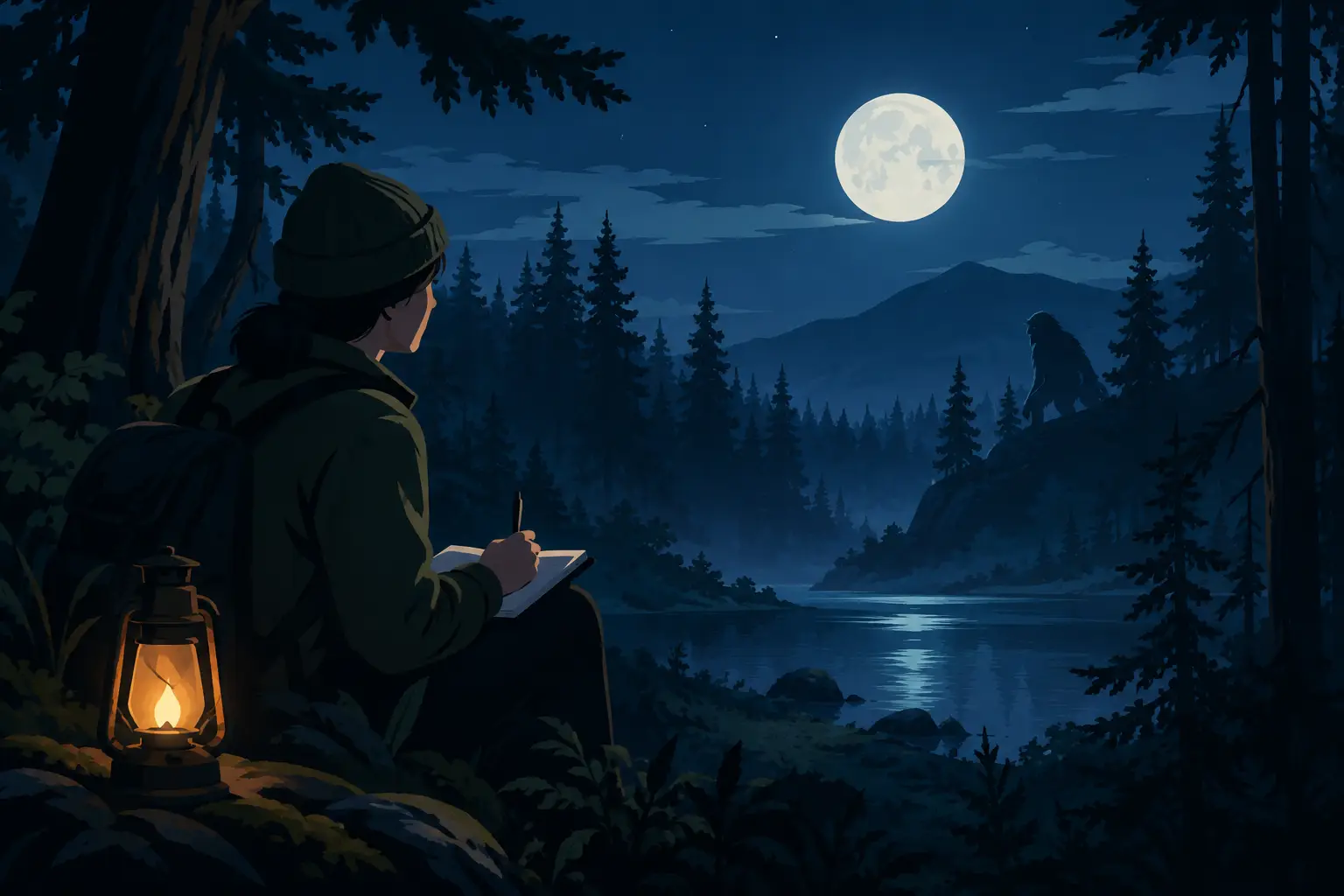
A monster can belong to a map, but it does not belong to whoever finds the coolest version online. It may be tied to a town’s labor history, a family’s warnings, a tribal nation’s living traditions, or a place where people have been telling strange stories for generations. Ethical folklore research begins there: with the understanding that a legend is more than raw material for a creepy caption, a podcast episode, or a collectible creature.
For anyone drawn to America’s legendary creatures, that is not a limitation. It is the part that makes the story worth bringing home. A flattened legend is forgettable. A creature with a real region, a real history, and a story told with care has teeth.
What Ethical Folklore Research Protects
Folklore is often treated like public-domain treasure: old, ownerless, and waiting to be repackaged. Sometimes a story is broadly shared and has traveled through newspapers, campfire retellings, books, and local tourist lore for decades. Even then, its meaning can change depending on who is telling it and why.
Other traditions are not open for casual use. Sacred narratives, restricted knowledge, ceremonial beings, and stories held within Indigenous, religious, or close-knit cultural communities require a different standard. Public visibility is not the same as permission. Finding a version in print does not automatically make it appropriate to turn into entertainment, merchandise, or a monster mascot.
Ethical folklore research asks a few plain but powerful questions. Who carries this story? What purpose does it serve? Is this creature a playful local boogeyman, a warning attached to a real danger, or part of a living spiritual tradition? Who benefits when the story is retold?
The answers will not always be neat. That is the point. Folklore is alive precisely because it shifts between tellers, places, and generations.
Start With Place, Not the Creature
A quick search can produce a familiar outline: strange beast, dark woods, sighting, newspaper clipping. That is a lead, not a finished history. Begin by locating the story in its actual landscape. Learn the county, watershed, mountain range, highway, neighborhood, or shoreline where it took shape. Then ask what was happening there when the tale gained traction.
A lake monster might grow from fishing culture, dangerous water, and decades of visitor stories. A shaggy thing in the woods may have become famous through a tabloid boom, but older versions could be tangled up with settlement, logging, migration, or regional humor. The details matter because they keep every state from becoming the same generic moonlit forest.
Primary sources are the best trail markers when they exist. Look for local newspaper archives, historical societies, library collections, oral-history projects, museum records, and interviews preserved by the people closest to the tradition. Pay attention to dates. A story presented as ancient may actually be a twentieth-century invention, a commercial hoax, or a modern remix of much older beliefs. None of those origins make it less interesting. They simply call for honest framing.
When sources disagree, do not force a single official version. Contradiction is often part of the legend. Say that one account places the creature near a particular town while another moves it across the state line. Let the mystery keep some of its tracks in the mud.
Treat Search Results as Clues
Search engines reward repetition, not truth. The most copied paragraph may have started as an unsourced forum post, a tourism blurb, or a writer repeating another writer’s mistake. Trace claims backward whenever possible.
If a dramatic detail appears everywhere but no one identifies where it came from, label it uncertain or leave it out. The missing detail is better than a false one. A legend does not need invented age, fake eyewitnesses, or borrowed Indigenous language to feel eerie.
Know When to Step Back
The hardest part of ethical folklore research is accepting that not every compelling story is yours to adapt. This is especially true when research touches Indigenous traditions. Native nations are not a costume rack of ancient myths, and their stories are not interchangeable with mainstream cryptid lore.
Names, beings, and teachings are often simplified or distorted by outsiders. Some are sacred. Some are restricted by season, setting, or community. Some have been repeatedly mined by horror media until the original context is nearly buried. Repeating that harm with nicer packaging is still harm.
If a creature or story comes from a living culture, seek guidance from authoritative voices within that community. That may mean published work by community members, a cultural office, tribal library resources, or direct consultation when appropriate. It may also mean the responsible answer is to choose a different legend entirely.
That choice is not a creative defeat. America is crowded with oddities: local giants, phantom animals, roadside horrors, mine-country specters, storm-haunted waters, regional pranksters, and monsters born in the pages of small-town papers. Respectful research does not shrink the field. It reveals how many strange corners remain.
Give Credit Without Pretending Certainty
Folklore rarely has a single author, but it often has identifiable stewards. Name the region and community when you can. Distinguish between an old oral tradition, a newspaper-era sensation, a local nickname, and a modern internet legend. Those labels help fans understand what they are meeting.
Avoid claiming a creature represents an entire state when it really belongs to one city, one cultural group, or one particular stretch of road. A state-by-state collection can celebrate local identity without pretending state borders erase local differences. The goal is not to pin every legend under glass. It is to introduce people to the place that made it strange.
For a project like Fablins, that means a figure should feel like a doorway, not a substitute for the story. The character can be whimsical, eerie, and display-worthy while the accompanying lore remains clear about where its inspiration comes from and what has been changed for a new creative interpretation.
Separate Inspiration From Representation
A creature design is not a documentary. It may exaggerate horns, colors, claws, or personality for the sake of a memorable silhouette. That is normal in character design. Trouble begins when an invented look is presented as traditional fact, or when a sacred being is turned into a cute villain with no context.
Be direct about adaptation. Say a design is inspired by regional reports, local folklore, or a particular historical account. Do not imply that a community endorsed it unless they actually did. If consultants contributed, credit and compensate them fairly. If a story’s boundaries make adaptation inappropriate, honor those boundaries.
Build a Research Record Before You Build a Monster
Good research becomes much easier to defend when it is documented from the start. Keep notes on where every major claim came from, when a source was published, and whether it is firsthand, secondhand, or a later retelling. Record alternate names and conflicting versions rather than quietly choosing whichever one sounds coolest.
A useful research file also includes a short ethics note: what the story means in context, whether any community consultation is needed, what details should not be used, and how the final version will distinguish fact from creative invention. This is not bureaucracy haunting the fun. It is how a creative team avoids building a whole campaign on one bad paragraph.
Be especially careful with images. Old photographs, illustrations, and archival material can carry rights restrictions even when the story itself is old. Credit creators where possible, get permission where needed, and do not treat an image found online as free to use. The same respect applies to contemporary artists and local storytellers whose work may be the reason a legend is visible at all.
Let the Legend Stay Weird
Ethics does not require folklore to become a lecture. It asks creators to make the mystery deeper than a list of spooky facts. A well-researched creature can still be funny, feral, adorable, terrifying, or all four at once. It can still haunt a shelf, start an argument at game night, and make someone proudly say, “That thing is from my state.”
The difference is that the best retelling leaves room for the people and places behind the monster. It does not strip away the roots to make the creature easier to sell. It gives the audience a reason to look past the fangs, follow the trail back home, and listen for the story still being told.